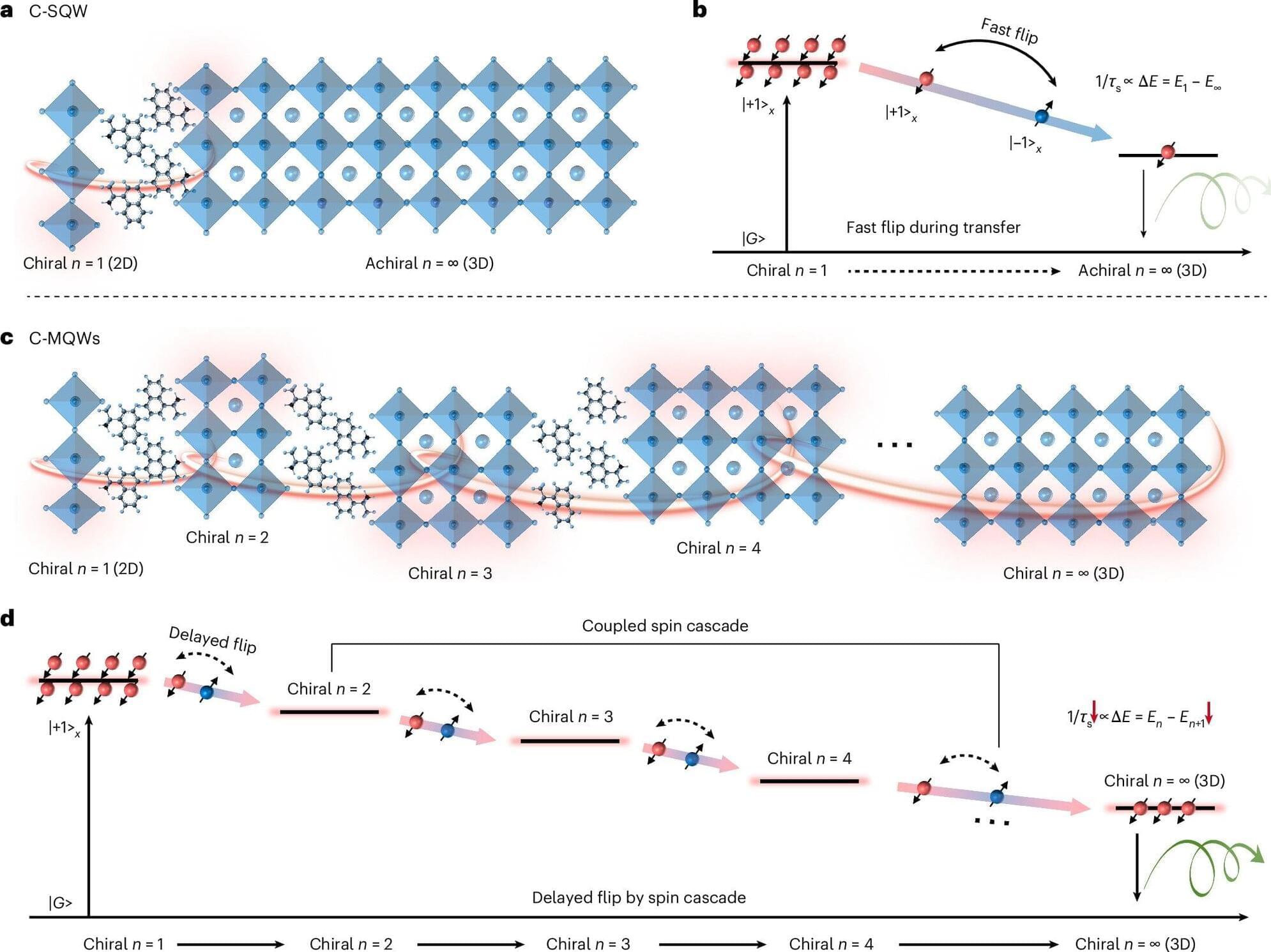
A research team led by Lu Haipeng, a professor in the Department of Chemistry at The Hong Kong University of Science and Technology (HKUST), has achieved a breakthrough in preserving spin information for optoelectronic technologies. The team has developed a perovskite chiral multiple quantum-well system that maintains spin polarization approximately 300 times longer at room temperature. The study opens new possibilities for future quantum technologies and next-generation spin-based applications. The study was published in the journal Nature Photonics.
Semiconductors underpin modern optoelectronic devices, yet the industry continues to face challenges in improving processing speed while reducing energy consumption. To overcome these limitations, researchers are exploring new approaches, particularly spin-based technologies. However, manipulating spin states at room temperature remains extremely difficult due to the rapid spin decoherence process.
To address these challenges, the HKUST research team developed a novel perovskite chiral multiple quantum-well system that enables an efficient “spin cascade” process. Using a two-step seed-assisted crystallization approach, the team constructed well-oriented quantum wells with varying widths and continuous intrinsic chirality across two-dimensional (n = 1), quasi-two-dimensional (n = 2, 3, 4, …) and three-dimensional (n = ∞) perovskite phases.