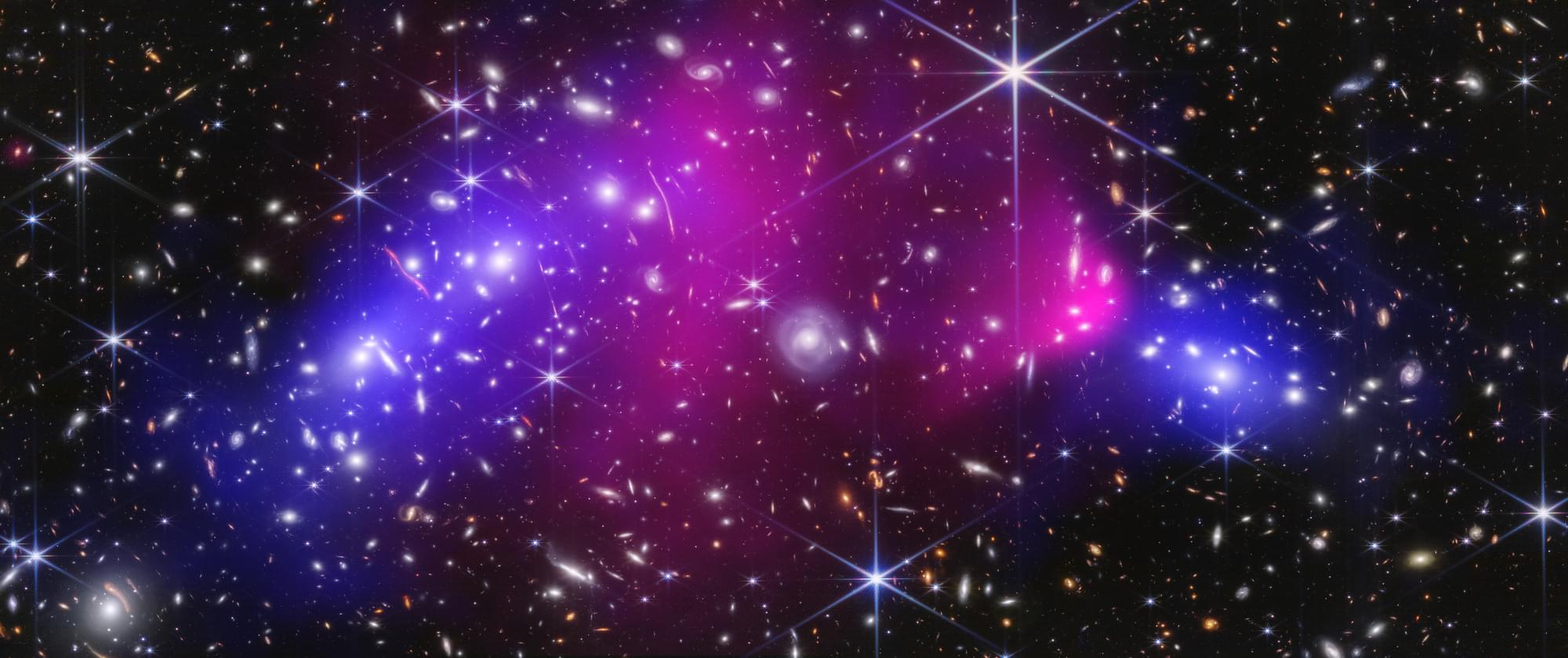
Modified gravity theories have a long and somewhat controversial history in scientific literature. Typically, these theories are put forth in an attempt to explain the observations we ascribe to dark matter by slightly tweaking either general relativity or Newton’s laws. While some have been successful at matching our observations of particular systems, these theories are often criticized for failing to generate consistent predictions about systems at different scales. For example, in the traditional formulation of modified Newtonian dynamics (MOND), Newton’s second law is modified to boost the effect of gravitational forces once an object’s acceleration drops below a certain value. With the right choice of cutoff, MOND can reproduce galactic rotation curves fairly well — but this same cutoff, when applied to galaxy clusters or cosmology, leads to faulty predictions.
One system that has been framed as particularly tricky for MOND is the Bullet Cluster. This structure consists of two subclusters that once passed through each other at high speeds, leaving an extended blob of hot gas strewn across the space between the subclusters. While this central gas is estimated to contain the majority of the system’s baryonic mass (e.g., stars, gas, and dust), gravitational lensing signatures remain strongest around the subclusters and suggest the presence of extra non-baryonic mass. If this excessive lensing were the result of a modification to Newton’s laws, it should be seen everywhere throughout the structure, not just around the subclusters. While dark matter halos provide a natural explanation for the separation, traditional MOND struggles to account for these observations.