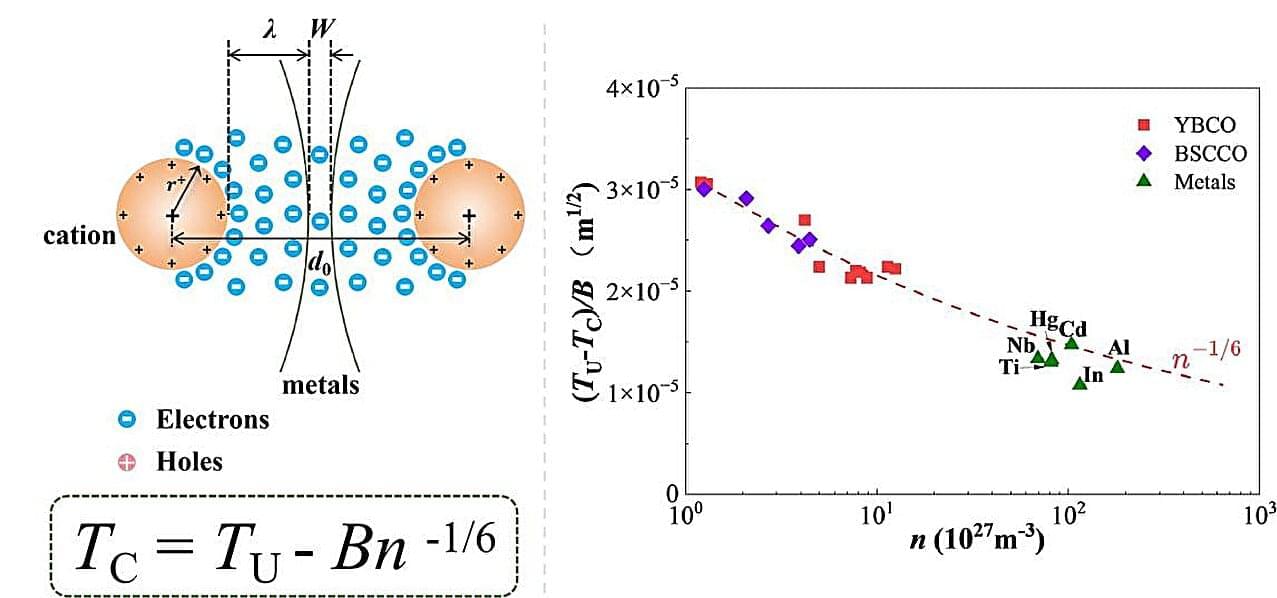
Superconductivity, the ability to carry current with no resistance, has been found in materials ranging from metals to oxides. Conventional Bardeen–Cooper–Schrieffer (BCS) theory explains low-temperature metal superconductors well, but struggles with high-temperature oxide superconductors.
Recently, researchers from the Shanghai Institute of Ceramics (SIC) of the Chinese Academy of Sciences developed a new phenomenological model that relates the superconducting critical temperature (TC) to several measurable material parameters: carrier concentration (n), thermal expansion coefficient (α), interatomic distance (d) and ionic radius. The work is published in the Journal of Materiomics.
The model is based on the formation and protection of superconducting channels for charge transport. A sufficiently high carrier concentration enables effective screening of impurities, particularly ionized impurities, thereby suppressing carrier scattering. According to Thomas-Fermi theory, the screening length (λ) of a three-dimensional free electron gas follows the power law λ ∝ n−1÷6, where n is the carrier concentration.