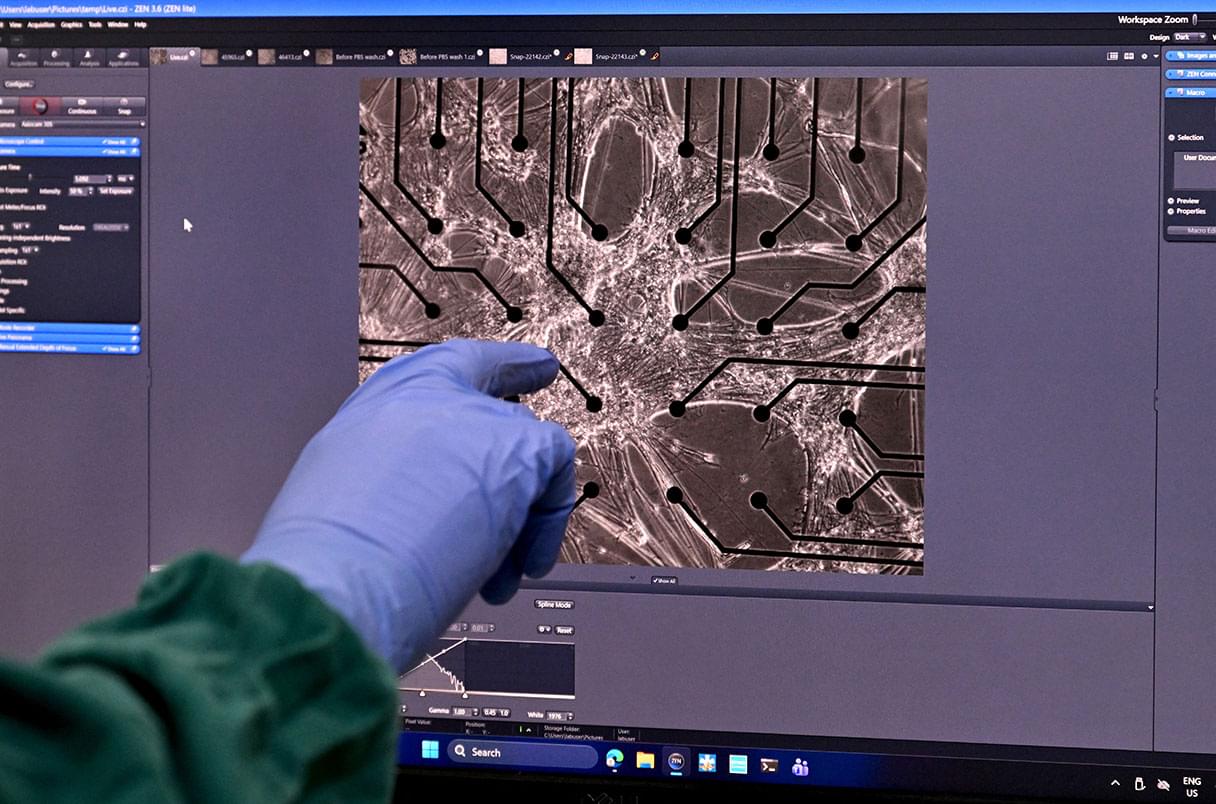
Computing is far from the original purpose scientists envisioned for brain organoids. They have become a standard fixture in neuroscience labs in large part because they offer a window into how the human brain develops, and how that process can go awry. But once these knots of brain tissue reach a certain level of complexity, their neurons begin to exchange electrical signals, which biocomputing researchers are eager to exploit.
Many of the approaches described at the conference work roughly like this: Researchers train a group of interconnected neurons to perform some function—say, guiding an agent through a virtual maze—by giving them electrical or chemical inputs reflecting features of the maze and interpreting their electrical activity. An algorithm transforms an organoid’s firing patterns into actions, such as turning its avatar in a specific direction. Depending on the response, researchers dole out rewards and punishments that, over time, encourage the organoids to make good choices and deter errors.
“We have no idea what they like and dislike,” says Corey Rountree, lead scientist at the biotech company 28bio. But his team has trained pairs of interconnected groups of cells called “connectoids” to play Pac-Man by giving them a rest period if they reach a fruit in the virtual maze and hitting them with a nasty burst of stimulation if they get nabbed by a pursuing ghost.