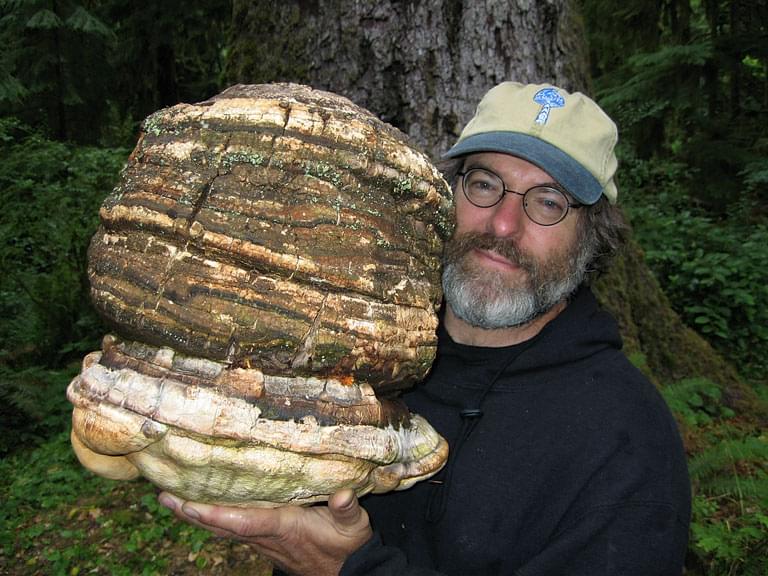
(Phys.org) —Mycologist Paul Stamets is espousing the health benefits of agarikon, a fungus that grows on trees in old growth forests in North America and Europe. He’s written and published a blog piece in the Huffington Post, describing the known antibacterial and antiviral abilities of the fungus and suggesting we take better care of our old growth forests as a means of survival in an uncertain future.
Agarikon grows to resemble a very large beehive and grows like a fruit hanging from the places where branches connect to trunks on old tall trees. Historians have noted that Native Americans mashed the fungus and used it as a medical remedy for a variety of ailments. Stamets notes that even the ancient Greeks knew about the medicinal qualities of agarikon, suggesting in an early text that it was useful for combating a host of diseases. Thereafter in Europe and the U.S. it became known as a treatment for several lung ailments including consumption (tuberculosis).
Stamets has been working with the University of Illinois to more closely study the medicinal benefits of the fungi, starting shortly after 9/11. He and the team there found that administration of agarikon showed anti-tubular activity when testing against the tuberculosis bacteria, reaffirming ancient beliefs. They also reaffirmed that eating the fungi can reduce inflammation and that it can be used to help combat both bacterial and viral infections. Thus far, he reports, research has shown strong activity against cowpox, swine and bird flu and the virus that causes herpes. In some instances, he notes the effectiveness was better in some cases than conventional therapies. He claims also that thus far there is no indication that agarikon is toxic to humans.