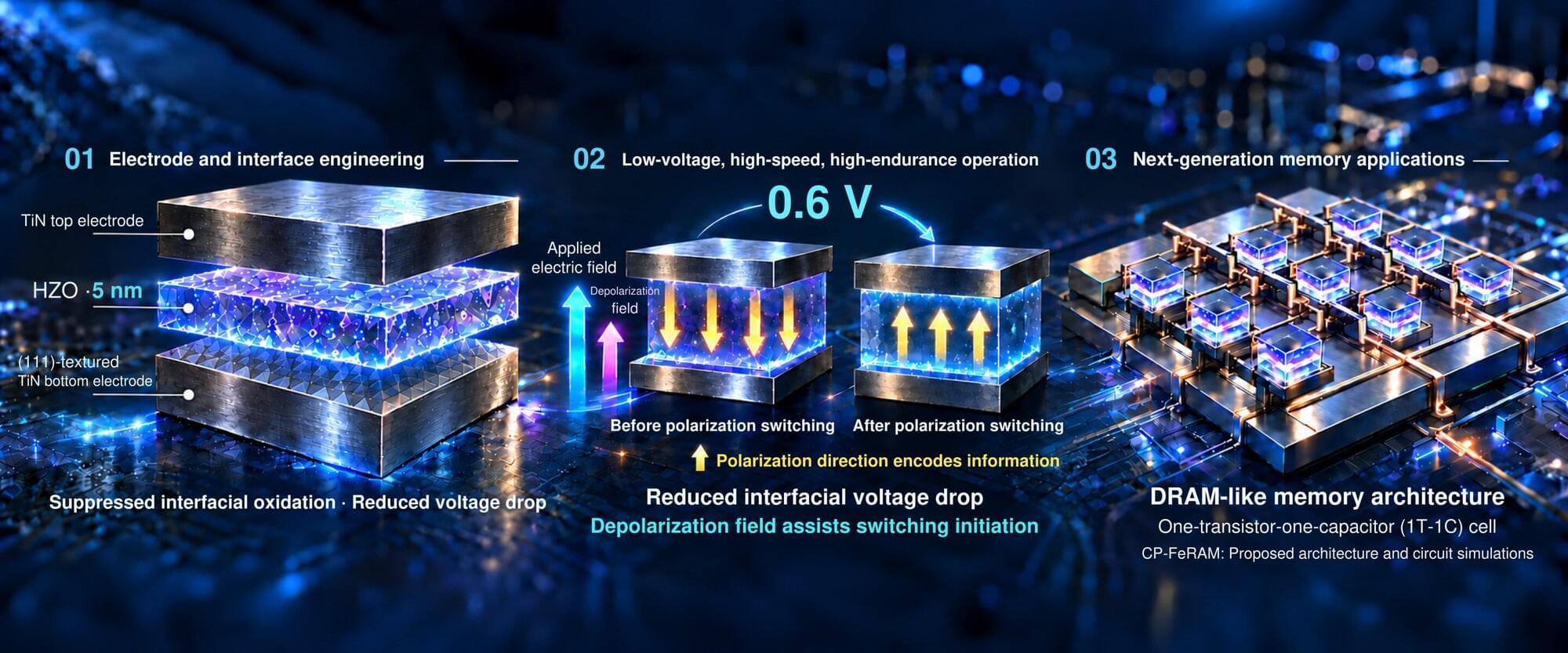
A breakthrough has been made toward overcoming both the speed and endurance limitations of low-power memory. A research team led by professor Min Hyuk Park of the Department of Materials Science and Engineering at Seoul National University College of Engineering has developed a ferroelectric capacitor that operates rapidly at a voltage as low as 0.6 V and can still distinguish between information states without electrical breakdown after 1 trillion switching cycles.
The achievement is significant because it offers a solution to a longstanding challenge in ferroelectric memory: the difficulty of achieving both fast operation and long device lifetime. By precisely engineering the interface between the electrode and the ferroelectric material, the researchers simultaneously achieved a low operating voltage, rapid polarization switching and high cycling stability. Based on these results, they also demonstrated the potential for the technology to be used in next-generation low-power memory with a structure similar to DRAM.
The research was conducted jointly with researchers from Hanyang University, Pohang Accelerator Laboratory and Samsung Electronics, and the findings were published in the journal Nature Communications.