In living cells, tiny molecules can generate coordinated motion across distances thousands of times larger than the molecules themselves. How such small movements give rise to coordinated motion over much larger distances is still not fully understood.
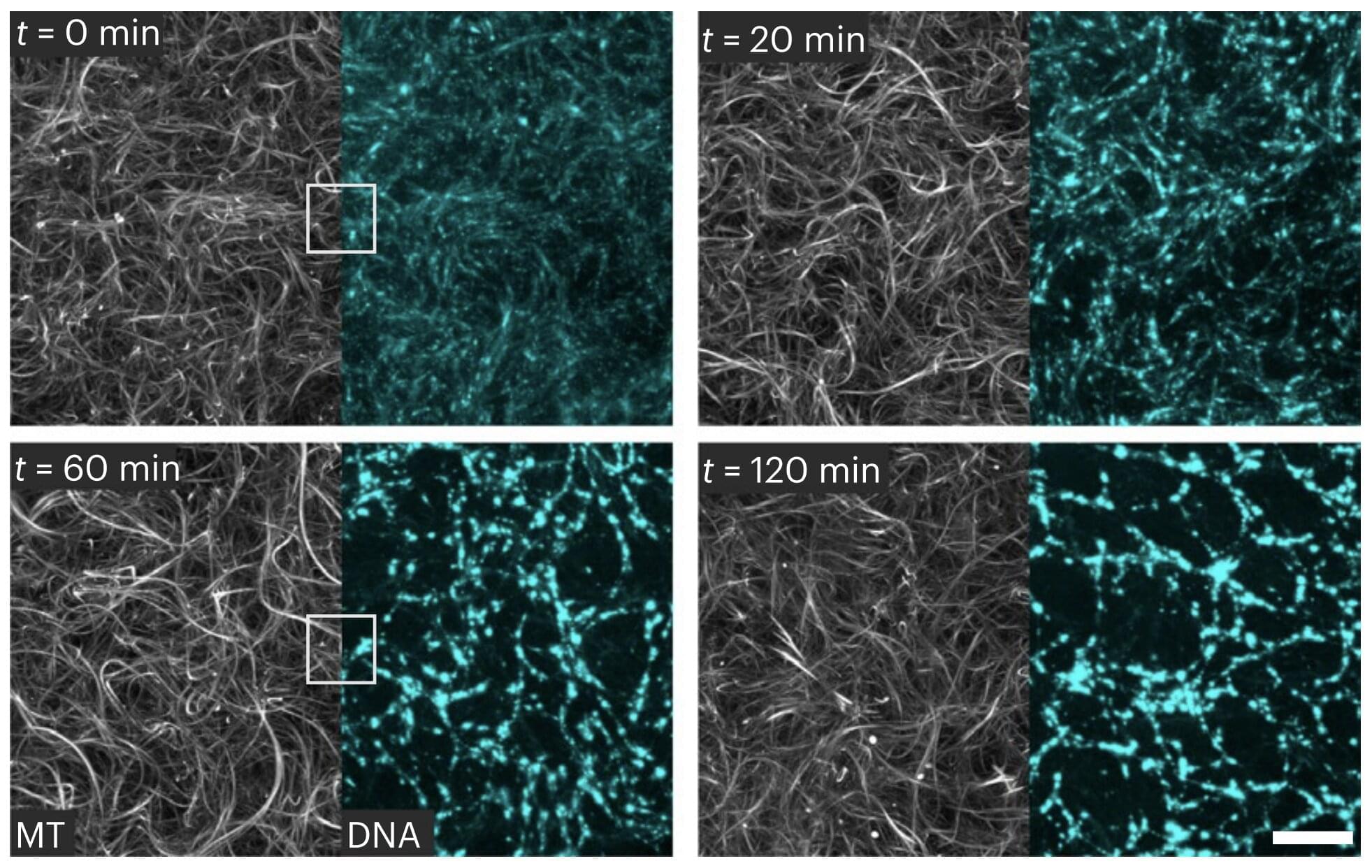
Researchers at the Weizmann Institute of Science and Technion recently examined how irregular currents in a lab-made fluid stretch and tangle DNA strands into a network. Their paper, published in Nature Physics, offers new insight into how mechanical forces can turn disordered fluid motion into coordinated, rhythmic flow.
“Our research is driven by a fundamental question: how can molecular-scale activity generate coordinated motion over distances thousands of times larger than the molecules themselves?” Alexandra M. Tayar, senior author of the paper, told Phys.org. “To understand the physical principles behind such collective behavior, we build materials from the bottom up, using a minimal set of purified biological components.”