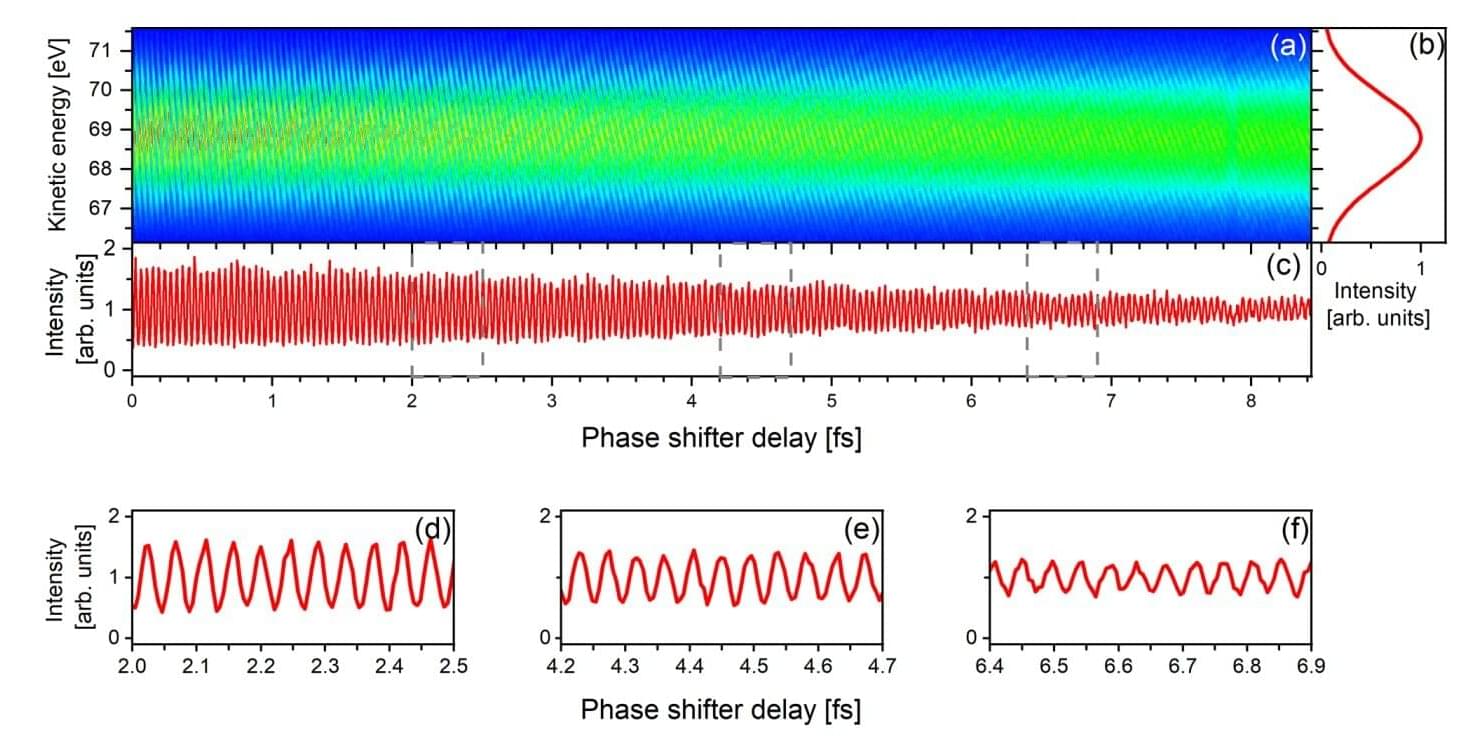
Researchers at the UVSOR Synchrotron Facility (Institute for Molecular Science, Japan) and partner institutions have observed the decay of a xenon 4D core hole, an inner-shell vacancy, directly in the time domain. They used pairs of phase-coherent extreme ultraviolet pulses from a synchrotron to make the photoelectron wave packets they released interfere. The contrast of the interference fringes decreased over a few femtoseconds as the delay between the pulses increased. A model using literature core-hole lifetimes of about 6 femtoseconds reproduced this rapid decay of the fringe contrast. The study is published in the journal Physical Review A.
Auger decay is an ultrafast process. A valence electron fills an inner-shell vacancy, and another electron is ejected. It dominates the decay of the xenon 4D hole. Until the mid-2000s, experiments mostly inferred such dynamics from the spectral widths of photoelectron lines. Attosecond streaking later made time-domain observation possible. While attosecond streaking has been widely employed for time-domain observations of Auger processes, the research team has introduced an alternative approach based on coherent pulse pairs. The present work extends the photoelectron wave-packet interferometry to core holes created by photoionization.
At beamline BL1U of the UVSOR-III synchrotron, two undulators in tandem, separated by a phase-shifter magnet, emitted phase-coherent pulse pairs. The photon energy was 93.4 eV, with a bandwidth of about 3%. The phase-shifter magnet set the delay between pulses with attosecond resolution. The pulses ionized xenon 4D electrons, and a hemispherical analyzer recorded photoelectron spectra as a function of delay. Helium, which has no comparable decay, served as a reference. Its fringe contrast revealed the instrument’s own contrast loss.