Confirmed: CERN finds signs of a one-in-10-billion particle decay.
Scientists spent more than 40 years searching for a particle transformation with one-in-10-billion odds. Now, CERN’s Large Hadron Collider has detected signs of an extraordinarily rare decay that could help reveal particles beyond the machine’s direct reach.
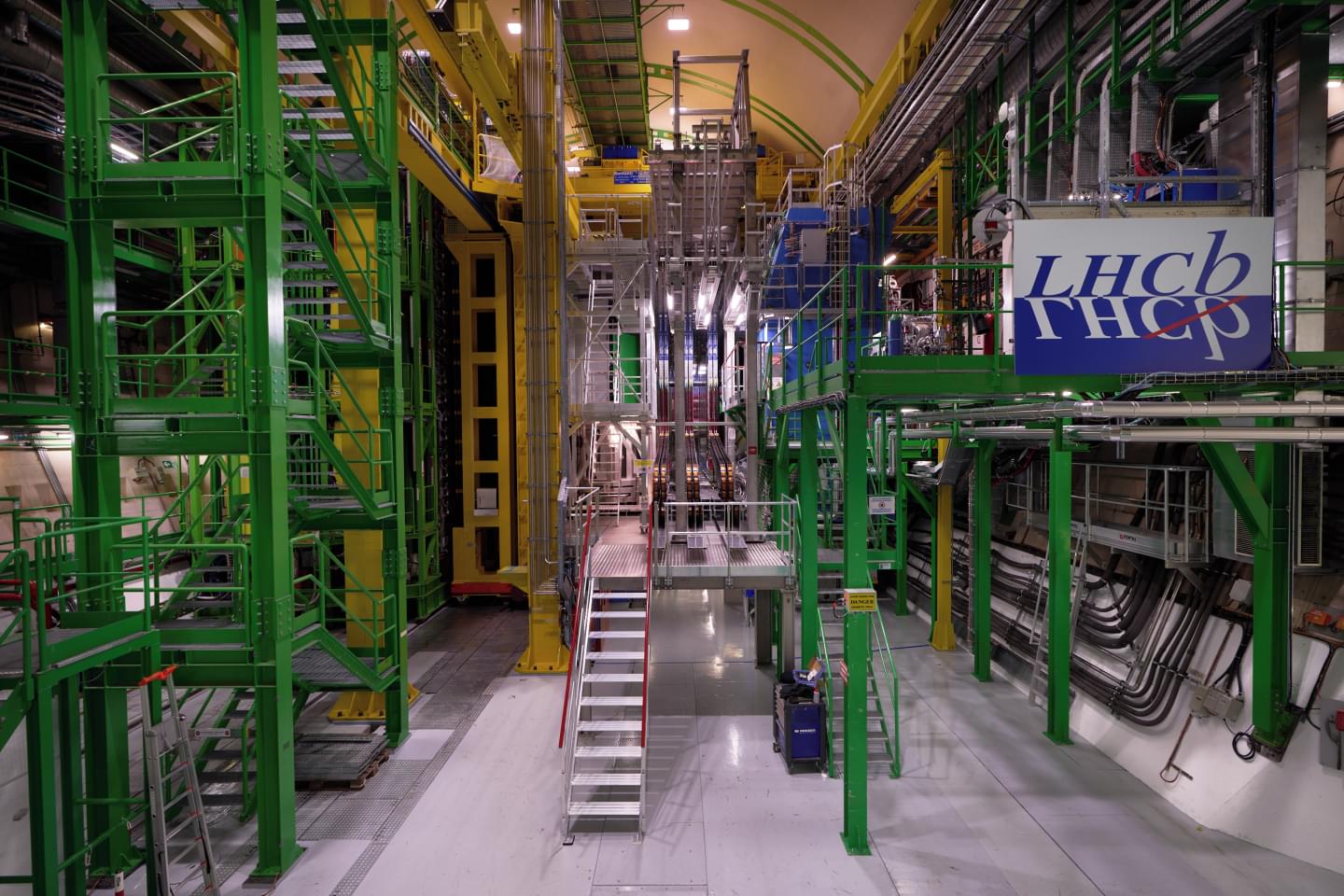
The finding comes from LHCb, an experiment that studies short-lived particles containing beauty quarks. One of these, called the B⁰ meson, is predicted to decay into a muon and its antimatter counterpart only about once in every 10 billion decays. Muons are heavier relatives of electrons.
That rarity makes this process especially useful.
Undiscovered particles could influence how often the decay happens, even if they are too heavy to be produced directly in LHC collisions. Measuring its frequency gives scientists another way to search for them. [Source: CERN](https://home.cern/lhcb-finds-evidence-of-one-in-ten-billion-particle-decay/)
Researchers describe this approach as a step toward exploring the “zeptoverse,” a realm of extraordinarily small distances. The search works by looking for subtle effects on known particles.
To uncover the signal, the team combined data collected in 2024 and 2025 with earlier measurements. An upgraded detector and machine learning helped separate the rare decay from an overwhelming background.
The result reaches 3.2 sigma, enough to count as evidence, but below the five-sigma threshold used to claim a discovery.
So far, the measurement agrees with the Standard Model, our leading theory of particles and their interactions. No new particle has been discovered.
The next step is to collect more data, confirm the decay, and measure it more precisely. Even a small departure from predictions could become a clue to physics we have yet to uncover.