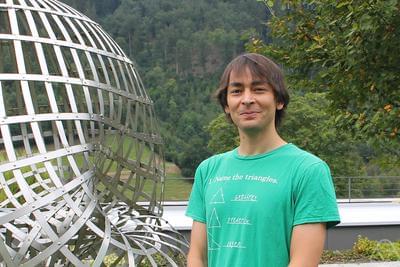
Who is the mathematician behind the Riemann Hypothesis claim—and why is the math world paying close attention?
Following the bombshell announcement that he and Claude may have cracked—and formalized in Lean 4—the 167-year-old Riemann Hypothesisv(along with the Generalized Riemann Hypothesis), many have been asking: Who is Levent Alpöge? And where is the paper?
If you look at his track record, this isn’t an outsider making a random claim. Alpöge is one of the brightest number theorists of his generation—and he has spent 2026 at the epicenter of AI-assisted mathematical discovery:
🎓 Deep Pedigree in Pure Math:
* Earned his PhD in Mathematics from Princeton under Fields Medalist Manjul Bhargava (2020), after completing degrees at Harvard (graduating *summa cum laude* with a 4.0 GPA and winning the Morgan Prize) and Cambridge.
* Served as a Junior Fellow in the Harvard Society of Fellows (2021–2025), specializing in number theory, arithmetic statistics, and elliptic curves—and even co-authored major work proving Hilbert’s tenth problem is undecidable over the ring of integers of any number field.
🤖 From Pure Math to AI-Assisted Breakthroughs:
* Now a Member of Technical Staff at Anthropic, Alpöge has been systematically testing what happens when top-tier human intuition pairs with frontier #LLMs.
* Just this summer alone, he used Claude to find an explicit counterexample to the Jacobian conjecture (open since 1939), construct long-sought Hadamard matrices, produce a counterexample to the Carathéodory conjecture, and propose a solution to Hopf’s problem.
🔍 Where Things Stand Now (As Covered in Scientific American):
As Scientific American reports, an AI-assisted solution to the most famous open problem in mathematics would cap off a watershed year for AI in math. Crucially, Alpöge didn’t just drop an informal manuscript—he released the full argument formalized in Lean 4, a proof-verification language where a computer checks every logical step.
Now for the wildest detail—there is no conventional paper:
In a footnote to his 4-page overview, Alpöge revealed that a natural-language write-up of the argument generated with Claude runs to more than 250,000 pages. Calling a quarter-million-page manuscript completely unreadable, he withheld the prose and instead released the entire proof as raw code for Lean (a formal proof-verification system)—spanning 14 archive files and over 175,000 code files.
As Scientific American highlights, this puts mathematics in uncharted territory:
1️⃣ Machine verification comes first: Computers can check whether the 175,000 Lean files compile without logical gaps and whether the formal definitions truly match the Riemann Hypothesis.
2️⃣ Human understanding comes second: Alpöge candidly noted that he is releasing the formal code before mastering every surrounding piece himself—and that simplifying it into a readable proof for humans is his next task.
Even if every line checks out, it raises a profound question for science: What happens when an AI helps discover a valid proof that is 250,000 pages long before any human can fully comprehend it?
#mathematics #Riemannhypothesis #ArtificialIntelligence