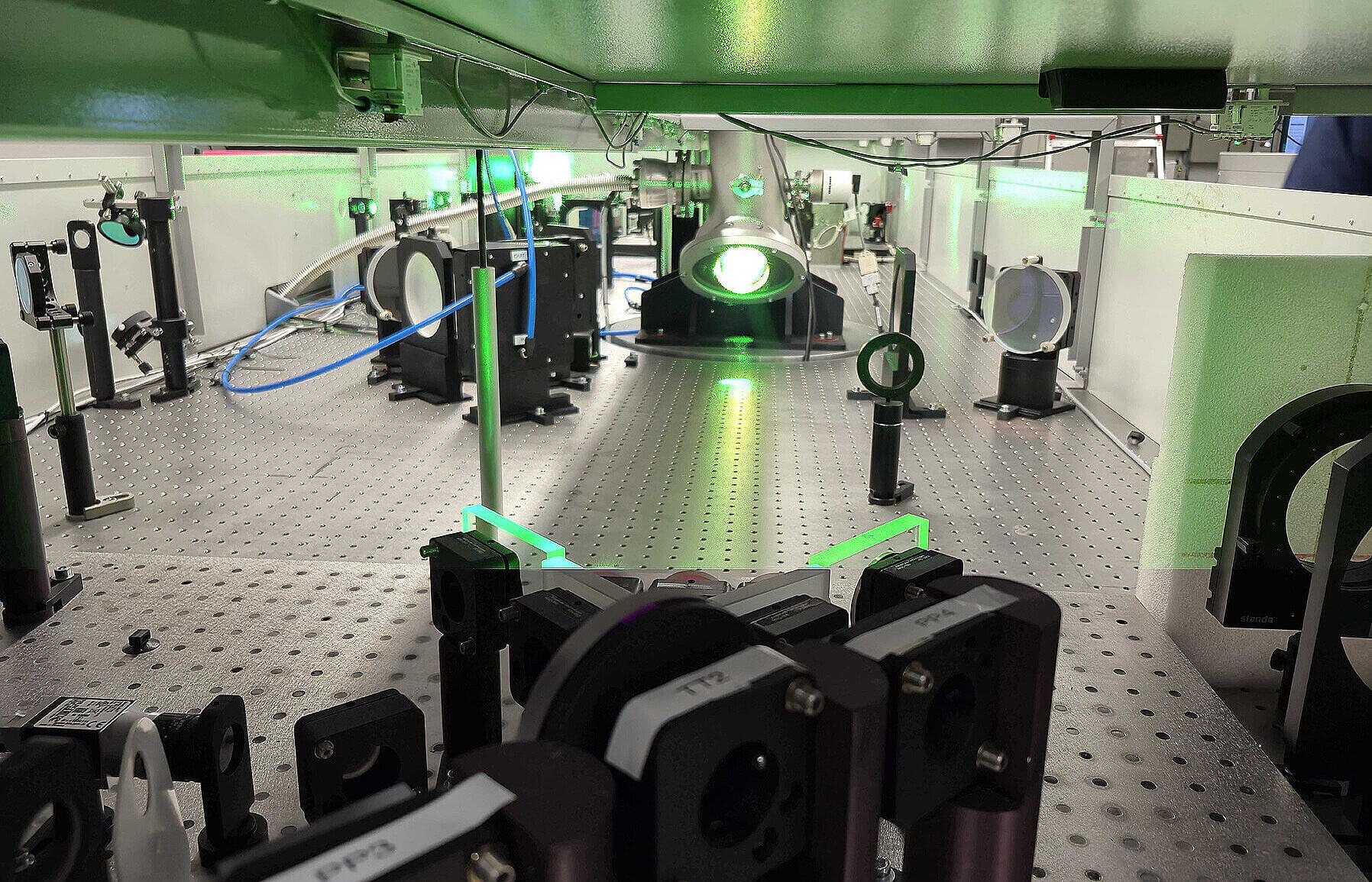
X-rays with wavelengths between approximately 2.3 and 4.4 nanometers, i.e., in the so-called water window, are particularly well suited to examining biological samples in their natural, aqueous environment. To date, however, it has been technically difficult to access this type of radiation at an appropriate quality and intensity, as only free-electron lasers in large-scale accelerator systems are capable of generating it.
A European research team from Heinrich Heine University Düsseldorf (HHU), the ELI Beamlines research facility and the University of Strathclyde has now demonstrated in model simulations that laser-plasma-based particle accelerators can offer easy access to this radiation range, as the researchers report in the journal Nature Communications.
Biological systems largely comprise water. By contrast, biological molecules contain, for example, carbon and nitrogen. When it comes to depicting such molecules at high resolution, electromagnetic radiation—for which water is transparent but which is strongly absorbed by other atoms—is helpful. And this applies precisely to soft X-ray radiation in the “water window.”