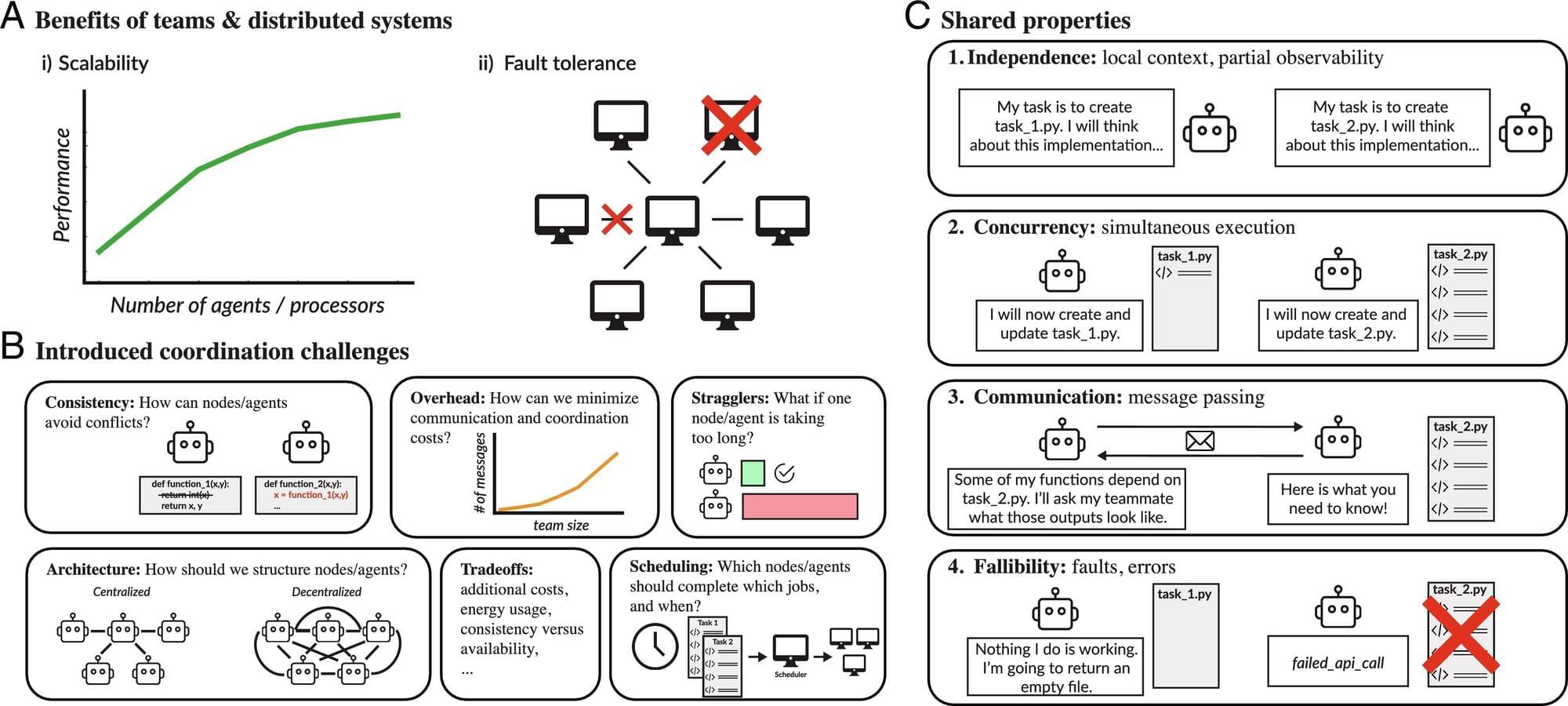
Poorly coordinated AI teams compound errors, waste resources, and underperform single agents. We draw on decades of distributed computing to ask: When do teams help? How many agents do you need? And how does structure impact performance?
💡 The Big Takeaway:
It turns out the secret to powerful AI isn’t just deploying *more* agents—it’s designing smarter systems for them to collaborate.
🔗 Read the full 🤖 More AI isn’t always better.
We’ve all heard the hype: “Just put multiple AI agents in a room and let them figure it out!” But a fascinating new study published in the Proceedings of the National Academy of Sciences (PNAS) reveals a major catch: poorly coordinated AI teams actually compound errors, waste resources, and underperform a single AI agent. 📉
Researchers drew on decades of knowledge from distributed computing to ask three big questions about AI teams:
1️⃣ When do they actually help? 2️⃣ How many agents do you really need? 3️⃣ How does team structure impact performance?
💡 Significance:
Just like human teams, AI agents need clear roles and structure to succeed. The research highlights that without proper coordination, AI agents end up stepping on each other’s toes, duplicating work, and creating bottlenecks. However, when tasks are thoughtfully structured and pre-assigned, AI teams can be significantly faster and more effective than a lone agent.
It turns out the secret to powerful AI isn’t just deploying more agents—it’s designing smarter systems for them to collaborate.
As we integrate AI into our workplaces and daily lives, this is a great reminder: coordination and clear communication matter, whether you’re managing humans or machines! 🤝
#ArtificialIntelligence #AIAgents #DistributedComputing
Large language models (LLMs) are growing increasingly powerful. Yet, fundamental constraints on the reasoning, memory, and performance of individual models has sparked recent interest in scaling abilities using LLM teams. With growing deployment of LLM teams at scale, there is a need for principled guidelines for when teams help, how many agents to use, and how structure impacts performance. Rather than building these teams through trial-and-error, we propose using distributed systems as a formal foundation for designing and evaluating LLM teams. Under this formal framework, we derive predictions about how task structure and team architecture should shape performance.