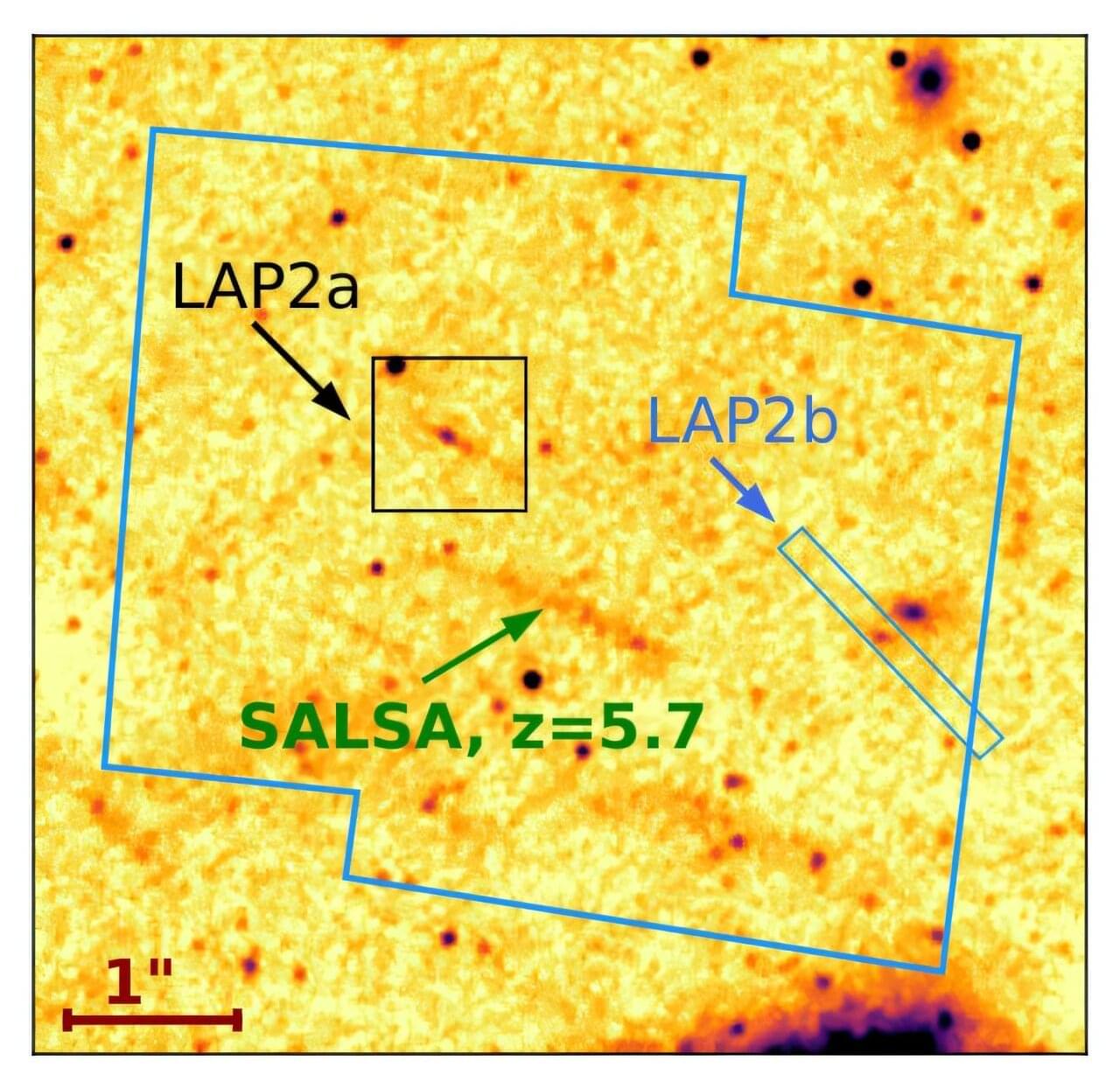
Astronomers using the James Webb Space Telescope (JWST) have studied one of the most metal-poor galaxies known. Seen as it was around 12.2 billion years ago, LAP2 is a tiny system with a stellar mass comparable to that of a massive star cluster. The research paper was posted to the arXiv preprint server on Nov. 3.
Early galaxies have very little metal, and over time they build up metals. Observations show that a galaxy’s metal content is linked to its mass in stars—a relationship known as the mass-metallicity relation.
JWST is now spotting a class of galaxies in the first billion years of the universe, called extremely metal-poor galaxies (EMPGs). These galaxies have only a few percent of the sun’s metals or less, and they serve as natural laboratories to trace the earliest stages of star formation and galaxy evolution.