Scientists have hypothesized that, in the fraction of a second following the Big Bang, minute black holes may have been forged within tiny, dense pockets that collapsed under their own gravity. If these primordial black holes are ever found, they could represent a significant component of dark matter—the invisible substance that makes up most of the universe’s matter.
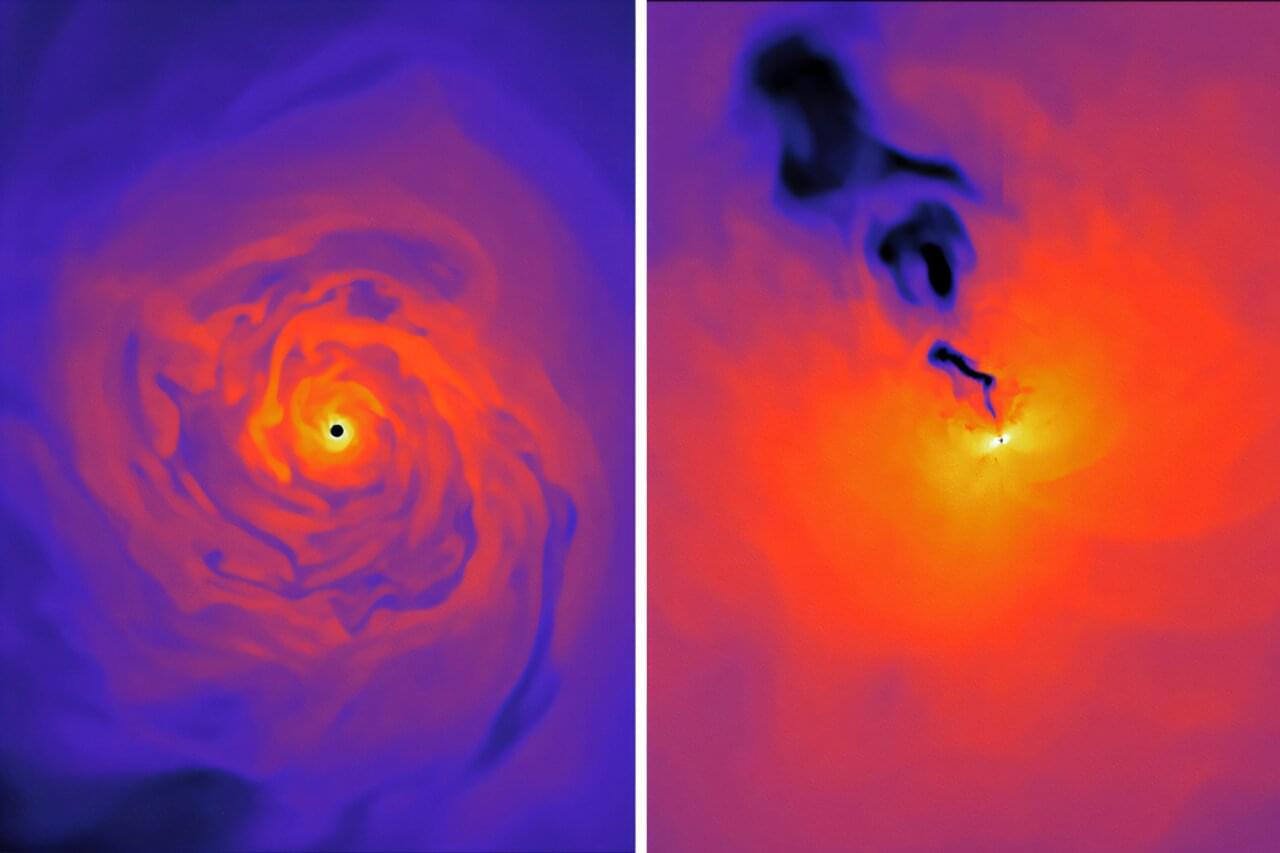
Now physicists at MIT and elsewhere have worked out a way that astronomers could detect a primordial black hole. The team carried out theoretical calculations and three-dimensional simulations to show what would happen if a lingering primordial black hole were captured by a modern, sunlike star.
In a study appearing in The Astrophysical Journal, the team’s simulations reveal a dramatic evolution: when an atom-sized primordial black hole with the mass of an asteroid is caught up in the gravity of a sun-sized star, it should quickly fall into the star’s core. Then, it would begin to devour the star from the inside.