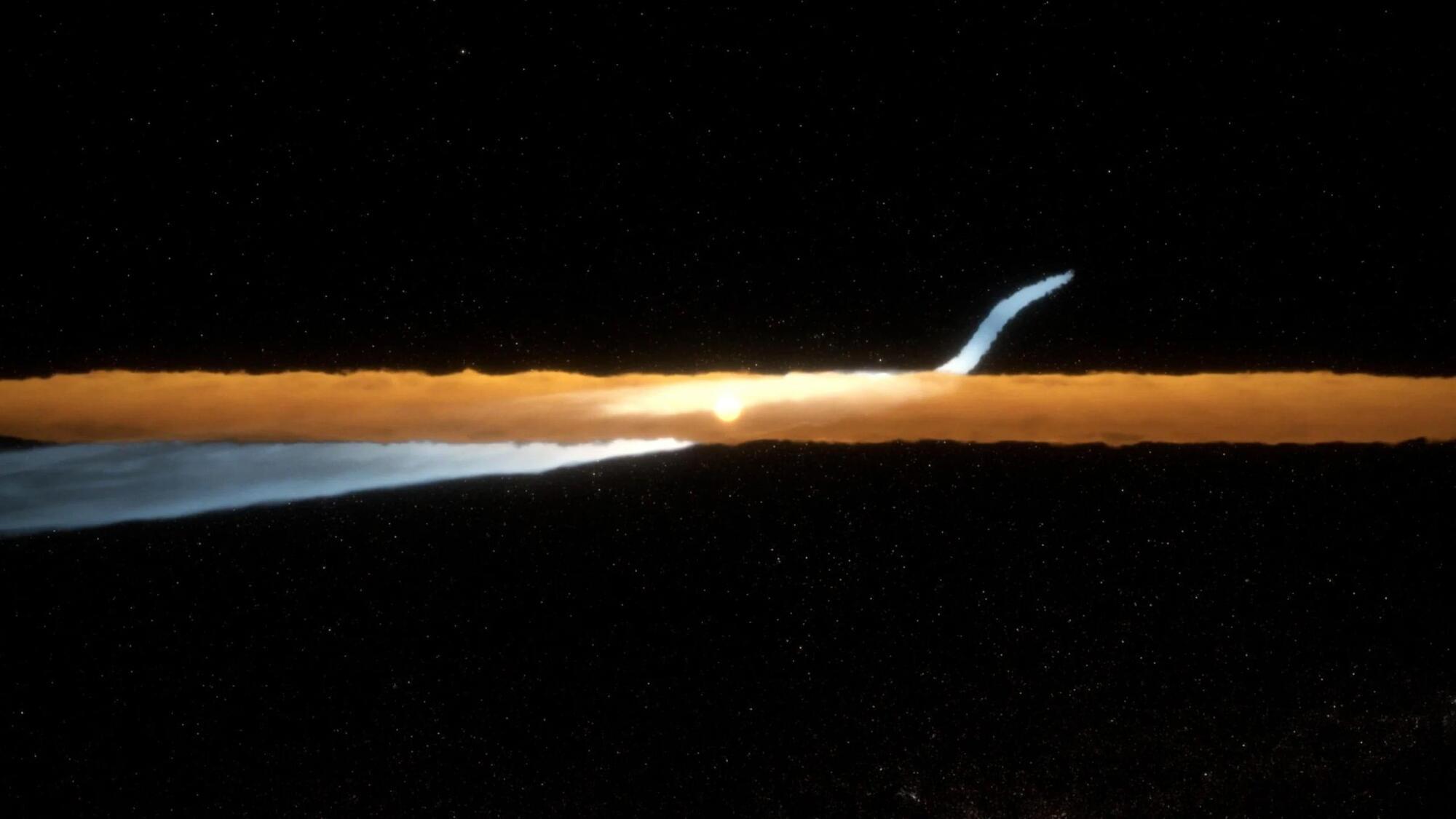
One possibility is that the impact generated enough heat to transform solid carbon into vapor, which later cooled and formed new particles. “It’s possible that the velocities involved in the collisions were so high that the carbon grains vaporized, turned into gas, and then recondensed as they cooled, and that’s how they became so porous,” said Wagner, a NASA Sagan Postdoctoral Fellow at Steward Observatory.
Hubble Reveals an Unexpected Shape
The new observations have also changed astronomers’ understanding of the Cat’s Tail’s position in space. Earlier interpretations suggested that the feature extended far behind Beta Pictoris from Earth’s perspective, creating the appearance of a long structure stretching away from the star.