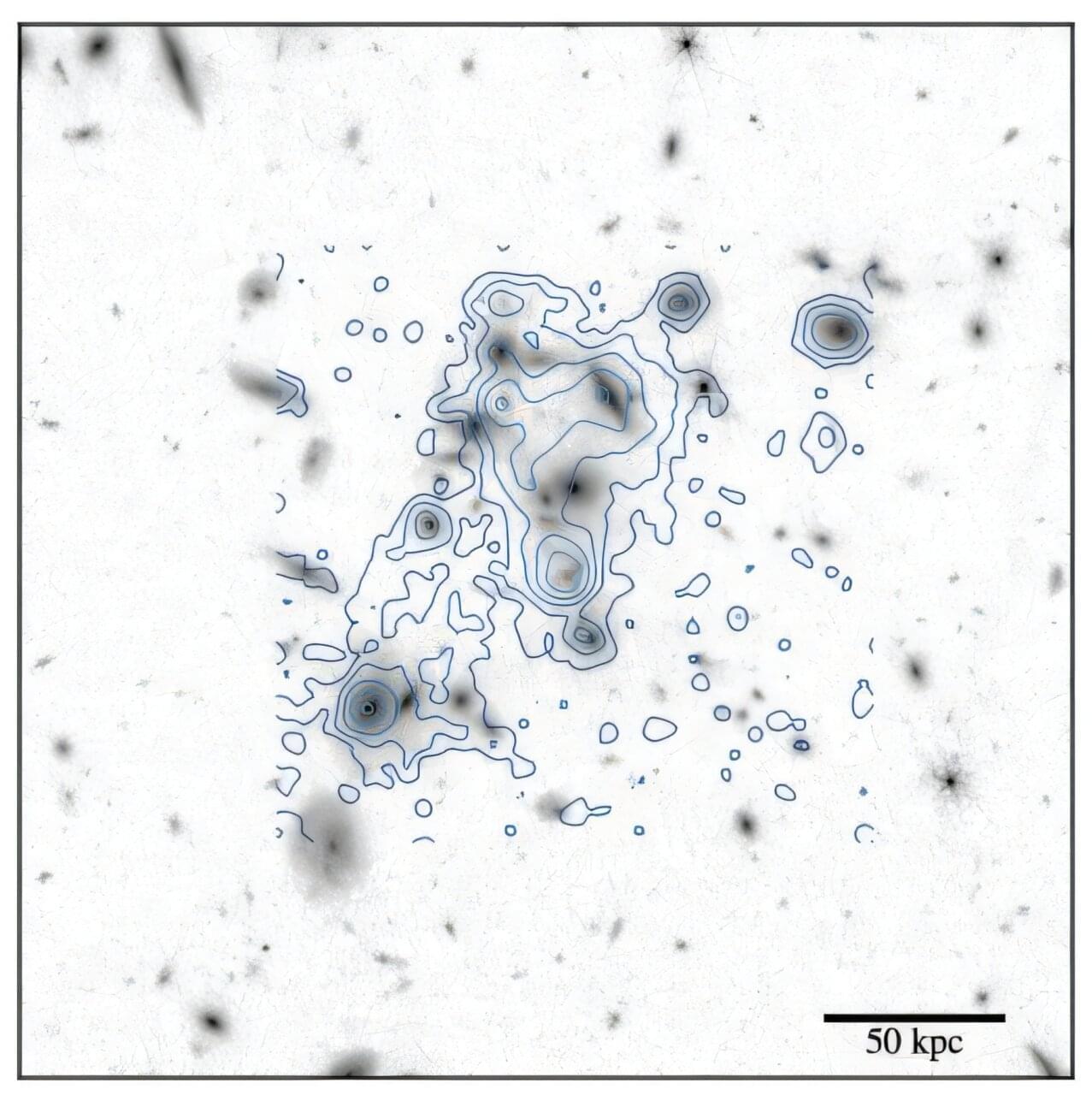
An international team of researchers, led by Jonathan Freundlich (University of Strasbourg, Astronomical Observatory), has revealed how a dense cosmic environment depletes galaxies of their gas. By mapping the molecular gas in a galaxy group located 7 billion light-years away, they found that the galaxies in this group harbor, on average, gas reservoirs reduced by more than half compared to similar isolated galaxies. The results of this study are published in the journal Astronomy & Astrophysics.
The history of the universe is marked by a peak in star formation 10 billion years ago, followed by a drastic drop in the star formation rate. This decrease can be explained by a combination of several factors: the ejection or heating of the gas used to form stars by stellar winds and black holes, a drying up of the fresh gas supply, internal structural transformations or environmental disruptions.
Insofar as the majority of galaxies are located in groups, environmental effects play a major role. These include tidal forces, which deeply deform galaxies and destabilize their gas during close encounters, as well as interaction with the hot gas of the intergalactic medium, which strips gas from galaxies and blocks their external supply. However, measurements of the amount of molecular gas remain particularly rare within galaxy groups despite its role as the essential fuel for star formation.