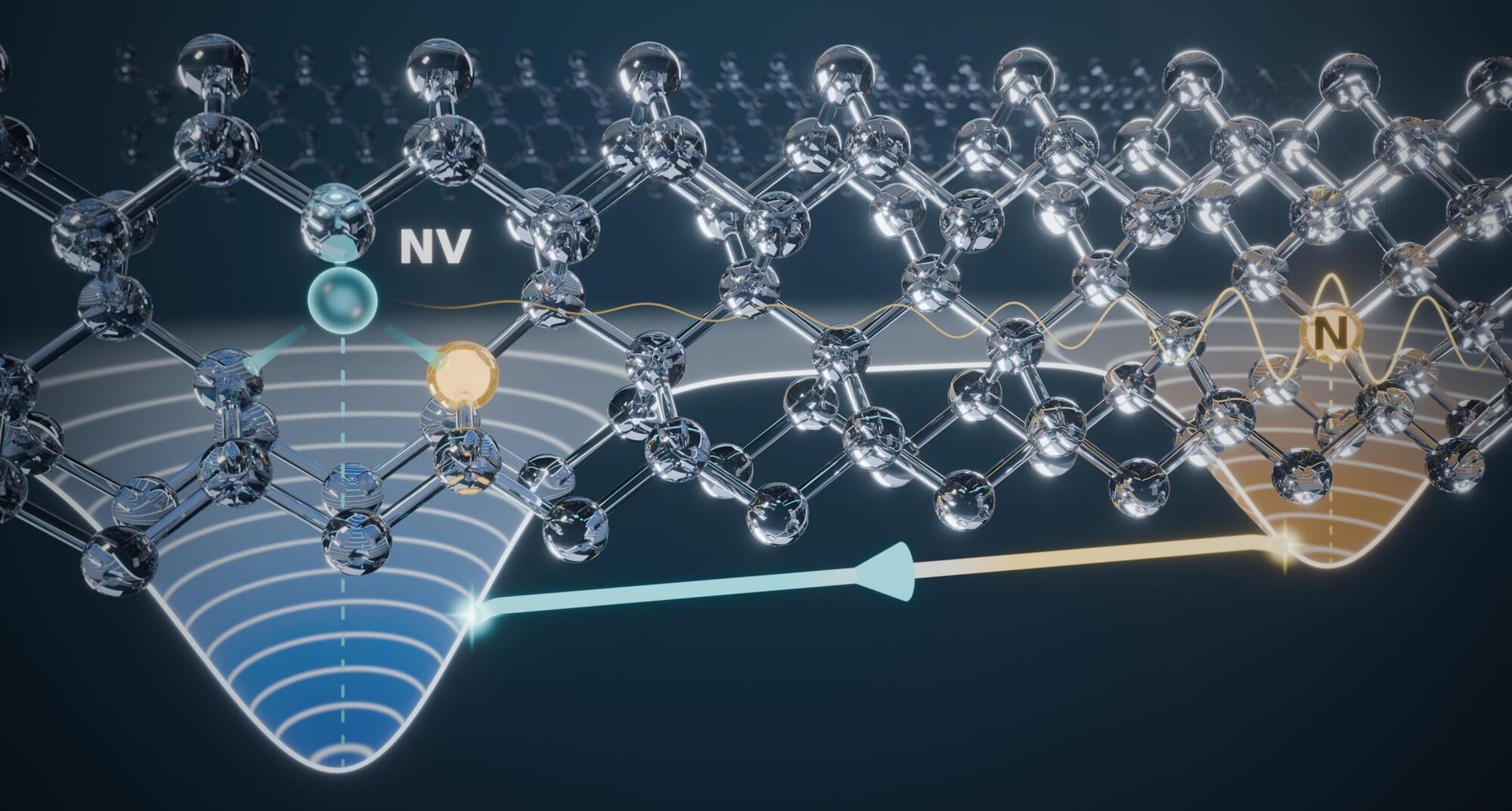
A diamond’s most useful quantum properties come from defects, places where the regular arrangement of carbon atoms is broken. One of these, a nitrogen atom situated next to a vacancy caused by a missing carbon atom, has become a key component in quantum technology.
Known widely as the NV center, short for nitrogen-vacancy, this defect can serve many roles. It can be a qubit that works at room temperature, a fundamental element in the construction of quantum computers and quantum networks, or a highly sensitive magnetic sensor that can be read using a laser to detect weak magnetic fields inside objects like living cells and microchips.
Researchers from Germany, Lithuania and the United States have now worked out how it returns to working order once it loses an electron. The explanation is that a replacement electron is supplied by a neighboring nitrogen atom through a quantum process called tunneling.