Turbulent flows are ubiquitous: they are found in clouds, in the ocean and even on other planets. Yet despite their chaotic nature, they also form large-scale structures that can be calculated and predicted. For example, while long streaks of clouds may appear orderly from the outside, their interiors are characterized by intense turbulence.
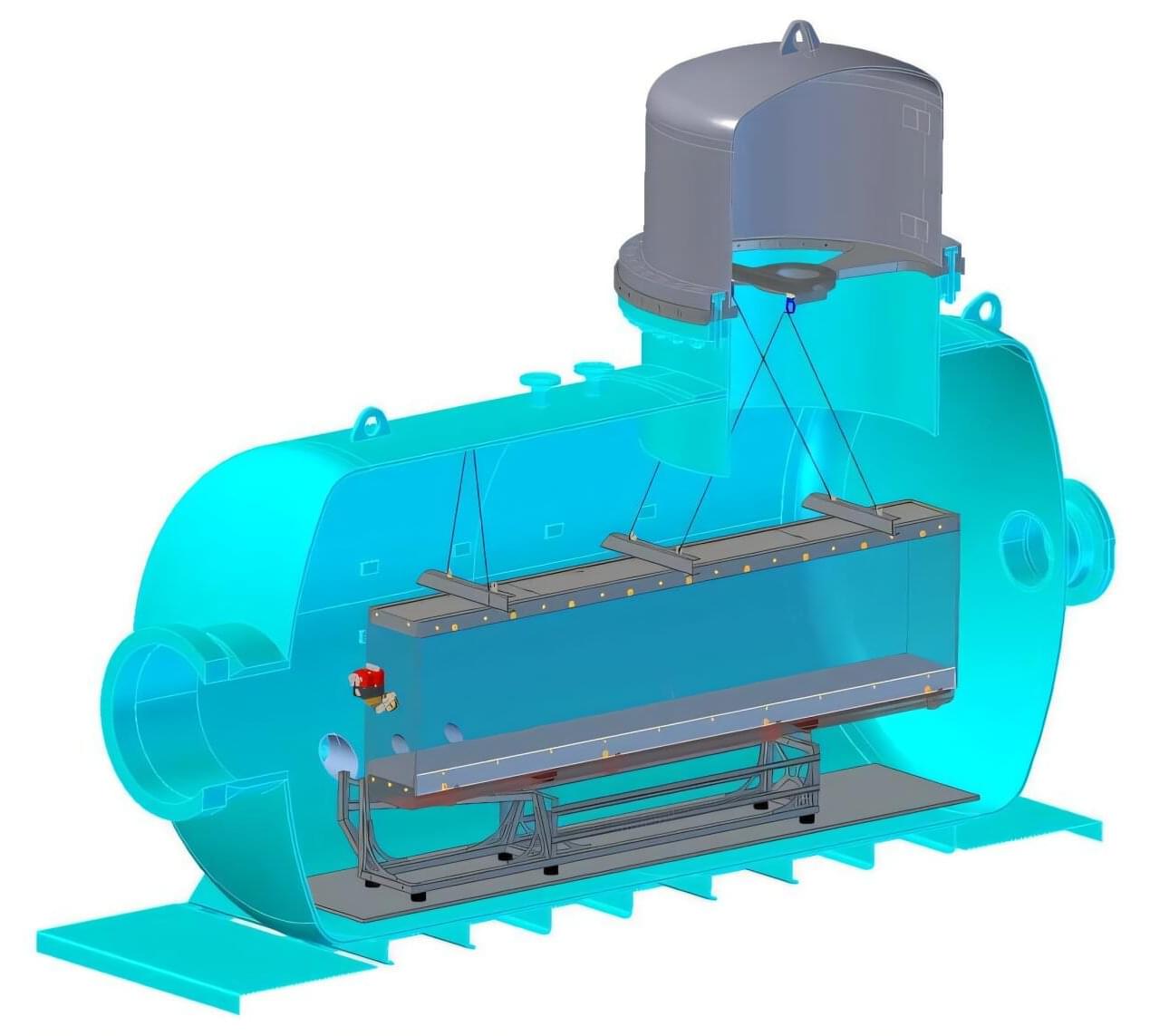
The high-pressure chamber at the Max Planck Institute for Dynamics and Self-Organization (MPI-DS), nicknamed the “submarine,” makes it possible to better understand the formation of these large-scale structures. Headed by research group leader Stephan Weiss and Director Eberhard Bodenschatz, the physicists have designed a special setup for such measurements. Their work is published in the Review of Scientific Instruments.
“The challenge is to generate flows with particularly strong turbulence, similar to those found in nature,” says Weiss. In their setup, the team uses a rectangular convection cell measuring 3.5 m long and 0.7 m high, whose temperature at the bottom and top can be regulated very precisely using heating and cooling plates. The experiments are conducted in a heavy gas (sulfur hexafluoride) at a pressure of up to 19 bar to replicate the large-scale turbulent flows found in nature on a smaller scale.