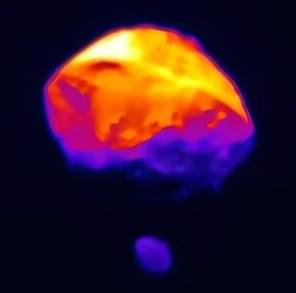
The European Space Agency’s Hera mission for planetary defense surveys its target asteroids with a combination of instruments, peering beyond the limits of the human eye. The larger Didymos asteroid—dominated by its dramatic equatorial ridge—is seen here from just 28.5 km (17.7 miles) away, variously in visible light, multispectral and thermal infrared vision.
The monochrome image here was acquired by the spacecraft’s Asteroid Framing Camera, used for both navigation and scientific observation, delivering a spatial resolution of approximately 2.7 m per pixel.
“This view reveals the variety of surface features across the spinning-top-shaped Didymos, with a boulder-rich area as well as clearer regions and traces of what might be landslides toward its central ridge,” notes Patrick Michel, Hera principal investigator, director of research at CNRS / Observatoire de la Côte d’Azur.