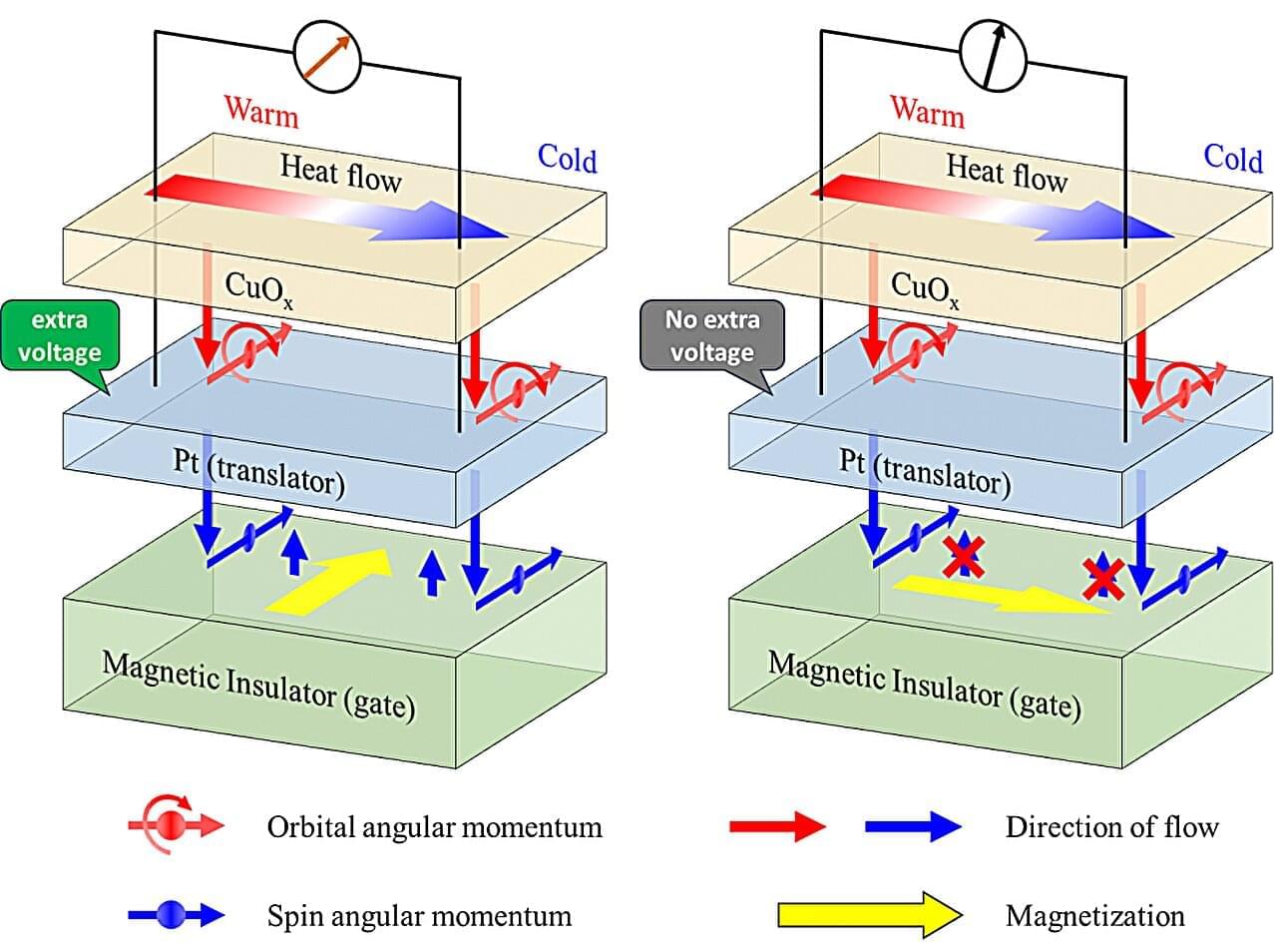
Researchers at National Taiwan University (NTU) have reported the first experimental evidence of heat-current-driven transverse accumulation of electrons’ orbital angular momentum, a phenomenon known as the orbital Nernst effect. The study was recently published in Nature Communications.
The Hall and Nernst effects are fundamental phenomena in electric and thermal transport. They describe how information carriers, such as electrons or spins, can develop a transverse response when driven by an electric field or a temperature gradient. They provide insights into the material’s electronic band structure and hold the key to applications.
Among the Hall family, the spin Hall and orbital Hall effects have attracted considerable interest because they allow an electric current to generate transverse flows of spin and orbital angular momentum, respectively. These forms of angular momentum can be transferred, directly or indirectly, to the magnetic moments in a material. When sufficiently strong, they can even switch the magnetization, providing a promising mechanism for writing information in spintronic memory devices.