Keeping a Quantum Computer’s Memory Safe — Without Breaking It.
Quantum computers are extraordinarily fragile. Their building blocks — qubits — are so sensitive that even a stray glance from the environment can corrupt the information they hold. The leading fix is called quantum error correction: you spread your precious data across many physical qubits so that a few failures here and there can be detected and repaired, like having multiple backup copies of a book where no single page matters.
But there’s a catch. While the data sits “encoded,” you often need to do things with it — flip states, swap values, or transform the information as part of a computation. Every time you touch the encoded data with a physical operation, you risk introducing exactly the kind of errors the encoding was designed to protect against. It’s like trying to edit a book that’s been shredded and filed across a thousand envelopes: every time you open one to change a word, you risk spilling the pieces.
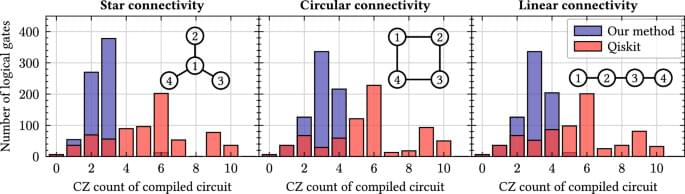
This paper introduces a new mathematical recipe for performing those operations safely and efficiently. The key idea is tailoring each sequence of operations to the specific hardware being used, and compiling entire operations as complete units rather than stitching together generic building blocks. The authors frame the design process as a kind of puzzle-solving exercise: find the sequence of physical gates (a specific two-qubit operation called CZ) that achieves the desired transformation on the encoded data while using as few gates as possible. Fewer gates means fewer chances for errors to creep in.
The approach works well enough to design circuits for quantum memories of up to 16 qubits — a meaningful scale for near-term machines. And because the resulting circuits are so lean, they serve as excellent foundations for “fault-tolerant” versions, which add built-in error checks (dubbed “flag gadgets”) that catch mistakes as they happen. As a proof of concept, the team found remarkably compact circuits for a popular small error-correcting code, using fewer physical two-qubit gates than anyone had managed before.
Alongside the theory, the researchers provide accompanying software, so the whole process can be automated. The broader message: instead of treating quantum error correction as a static storage locker and computation as a risky intrusion, this work makes the two work together — protecting information not just while it’s sitting still, but while it’s being actively used.
# Quantum ErrorCorrection # Quantum Computing # Quantum AI
Kuehnke, E.J., Levi, K., Roffe, J. et al. Hardware-tailored logical Clifford circuits for stabilizer codes. npj Quantum Inf 12, 185 (2026). https://doi.org/10.1038/s41534-026-01404-x.