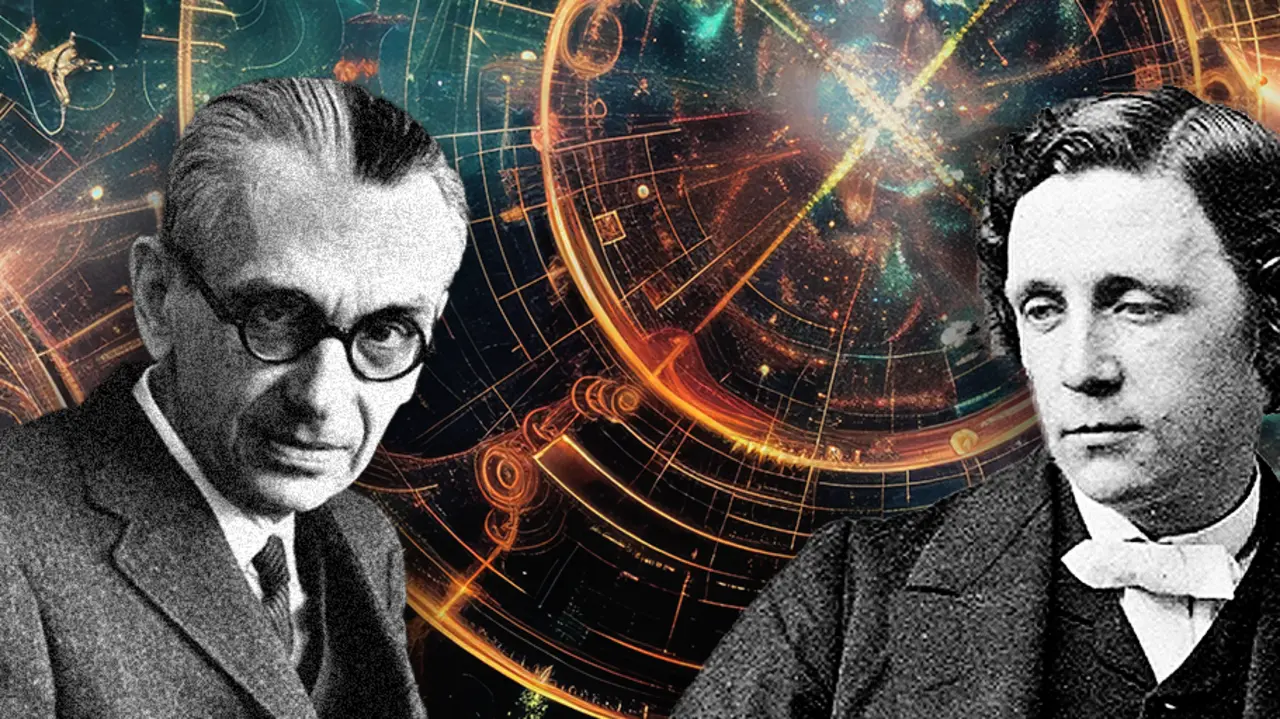
The classic story of science and mathematics was that reason could reach through to some pure, complete understanding of the world. But from Lewis Carroll’s work as a mathematician to Gödel’s incompleteness theorems, mathematics, and therefore the science it underlies, tells a different story. As Minh-Hoang Nguyen argues, the world, like that of Wonderland, is fundamentally incomplete. The notion that we live in a closed system that can be fully explained was not just unachievable; it was a philosophical mistake.
Mathematics is often mistaken for a discipline of quick calculations and precise answers. Yet mathematics is not fundamentally about arithmetic. At its deepest level, mathematics is an exercise of world-building.
Mathematicians start off with as small as possible a collection of assumptions, known as axioms. From this, they aim to construct an entire conceptual universe, be it to represent just mathematics or the physical world. Traditionally starting out with a simple notion of a set, increasingly complex structures emerge: numbers, functions, geometry, topology, and many of the abstract ideas that occupy contemporary research questions. Mathematicians, like architects or city planners, build up from a handful of principles to construct roads, boulevards and streets governed by internally consistent rules.