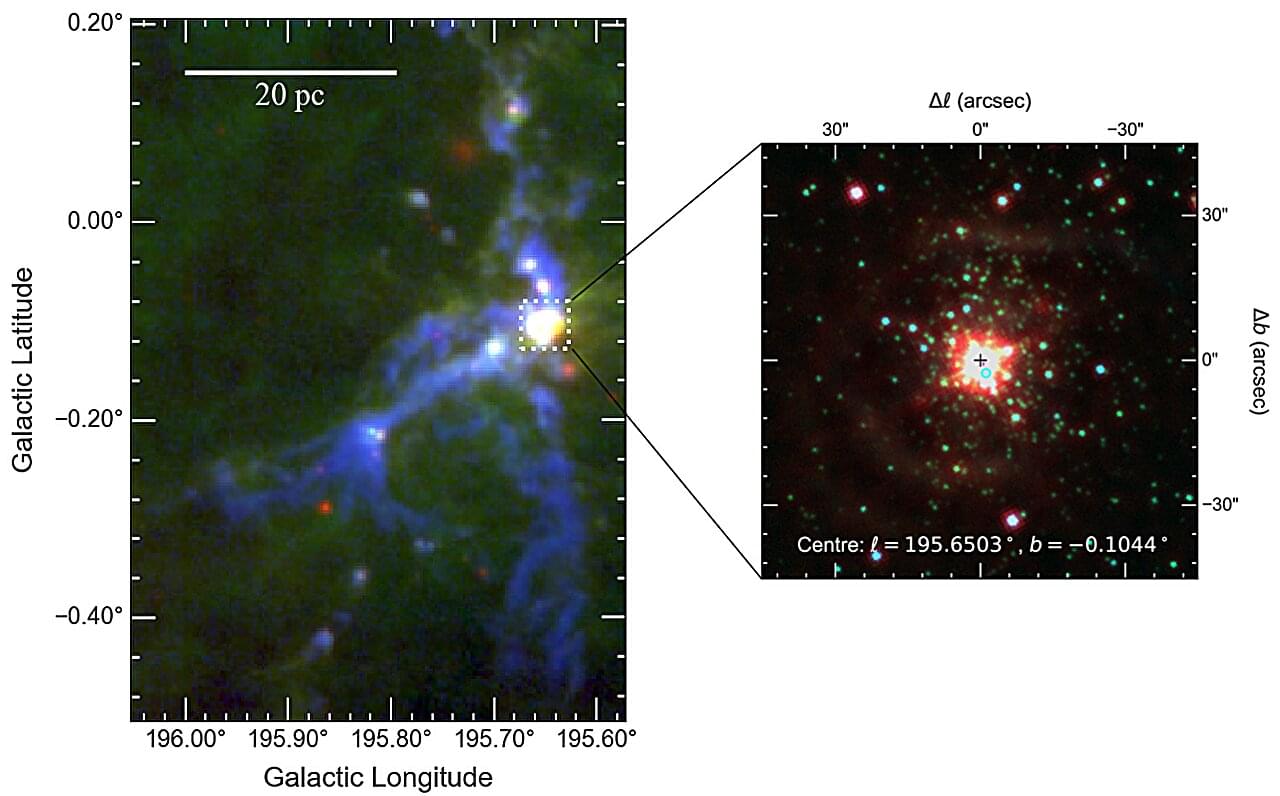
Massive stars often form in dense regions, called “hubs,” where filamentary structures made of star-forming materials meet. These star-forming complexes are “hub-filament” systems. Astronomers have discovered one such large network of molecular gas filaments in the outer regions of the Milky Way. It is called the λ-complex, and the structure is bigger than most known hub-filament systems. The research paper was published in the Monthly Notices of the Royal Astronomical Society on Nov. 17.
Stars that are young and are still forming are generally found in filamentary structures, whereas the big, massive ones are found in the dense hubs—where the filaments intersect. Almost all known hub-filament systems are found in the inner regions of the galaxy.
The few found in the outer galaxy are very far away, so they are challenging to study in detail. Because the outer parts of our galaxy have less gas, fewer heavy elements and weaker spiral-arm disturbances, the environment is harsher for new stars to form. So, researchers do not know if the star-formation rules of the inner regions apply to the outer parts.