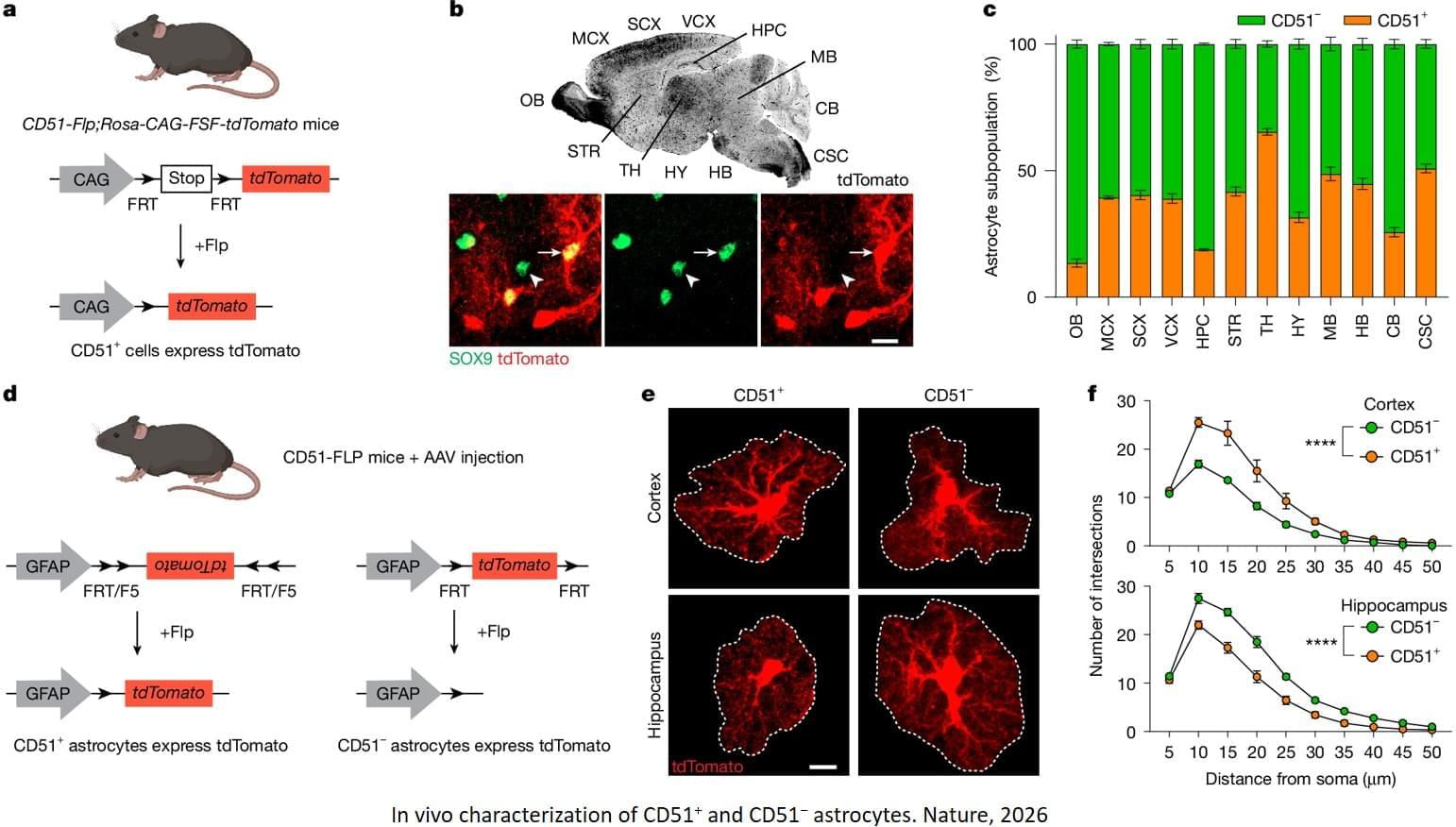
A new study in Nature answers a long-standing question about astrocytes, star-shaped cells that are the most abundant support cells in the brain and spinal cord. Scientists have long wondered whether astrocytes come in specialized types that do different jobs. Using a new genetic tool, the team showed that they do: distinct astrocyte subtypes help build connections between nerve cells, shape brain circuits involved in learning and memory and aid recovery after stroke.
“We’ve known for a long time that astrocytes do many vital jobs. They help nerve cells communicate, keep brain circuits running, nourish nerve cells and maintain the blood-brain barrier that protects the brain, and they respond to injury and disease. But it was not known whether specific jobs are carried out by specific types of astrocytes, as is the case for neurons,” said the corresponding author.
Researchers have long known that different types of neurons, the brain’s nerve cells, play specific roles. For instance, some neurons send signals that excite, or activate, other cells, while others send signals that quiet them. “Previous studies from our lab and others have shown that astrocytes are molecularly diverse. Some carry specific molecules on their surface or switch on a particular set of genes,” said a co-first author. “We had also shown in lab dishes that astrocytes with different molecular profiles behave differently, but that does not necessarily mean they do different jobs in a living brain. In this study, we asked whether different astrocyte subtypes have different properties and roles in the working brains of mice.”