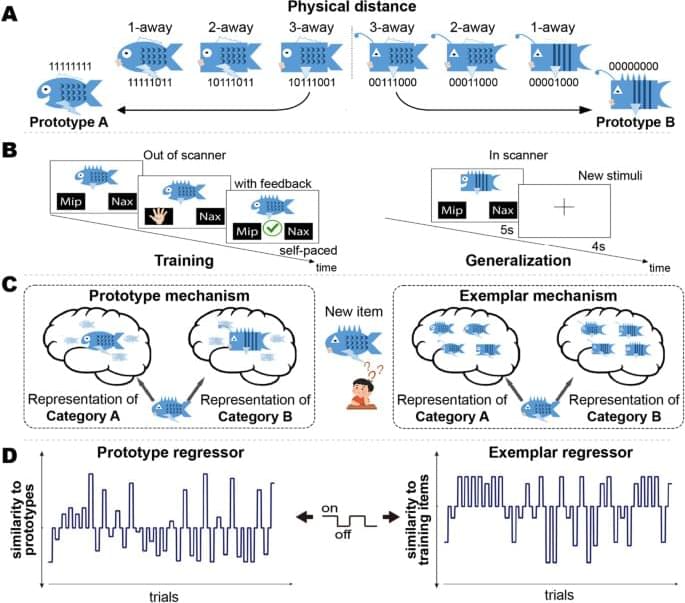
Learned knowledge does not consistently generalize to new contexts in autistic individuals, limiting potential for adapting to real-world demands. This challenge is hypothesized to stem from difficulties with forming abstract representations, potentially arising from perceptual processing that favors local details over the gestalt. We tested the prediction that generalization would be primarily based on exemplar-specific representations in autistic youth using computational modelling coupled with neuroimaging.
Sixty-four autistic adolescents without intellectual disability (69% males; ages 14–18 years) completed a category generalization task during functional magnetic resonance imaging at two time points. Computational models estimated abstract (prototype-based) and specific (exemplar-based) representations and underlying neural correlates. We further examined associations with adaptive functioning and moderation by autistic traits.
Contrary to predictions, we observed a consistent prototype-dominant majority, a subgroup who generalized without consistent representational reliance, and a small minority who failed to acquire category structure. Neural prototype correlates were observed in bilateral ventromedial prefrontal cortex (VMPFC), inferior parietal lobule (IPL), right frontal pole, and right lateral occipital cortex, while neural exemplar correlates were observed in bilateral cuneus. Better generalization predicted better real-world adaptive functioning. Moreover, greater prototype-related activation in left IPL predicted better adaptive functioning in participants with higher autistic traits.