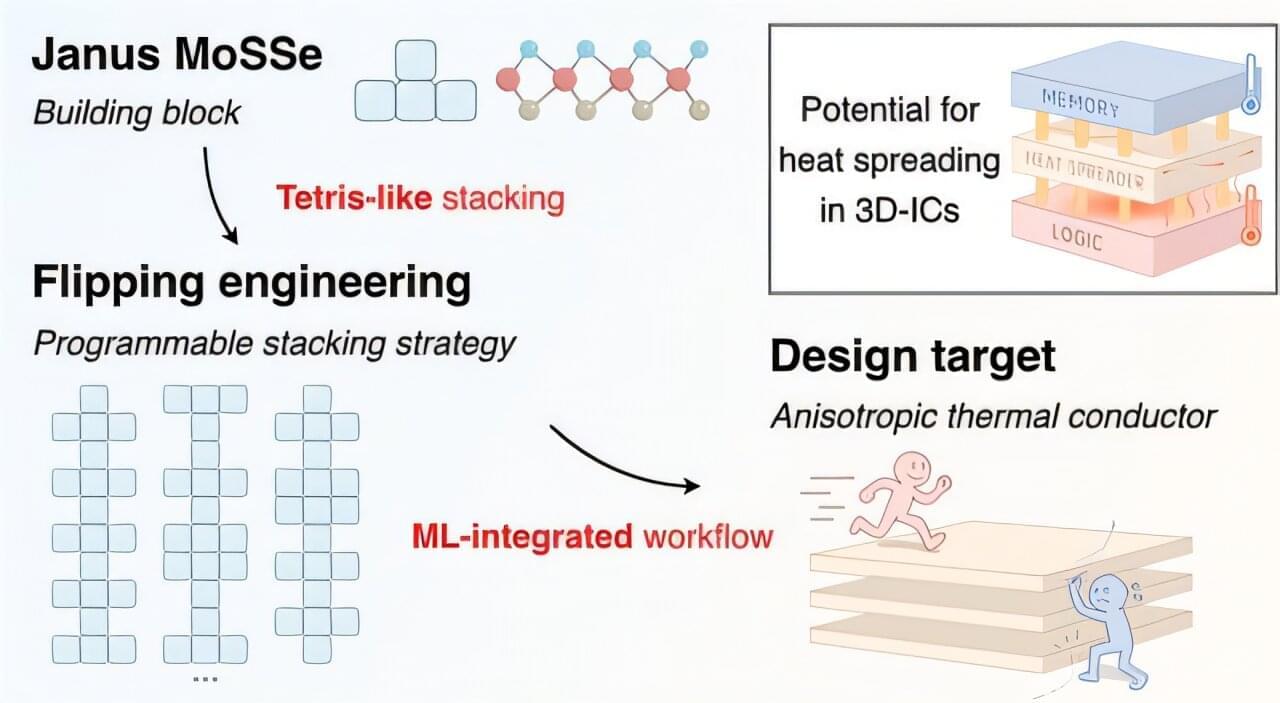
Stacking chips on top of one another could keep computers getting faster, but it creates a heating problem. Now, researchers from Japan have found that simply flipping atom-thin layers upside down could help steer that heat where it needs to go.
In a study recently published in ACS Nano, researchers from the Institute of Industrial Science, The University of Tokyo, and their collaborators propose “flipping engineering,” a new way to design layered materials that readily conduct heat along their layers while strongly blocking heat flow between them.
In three-dimensional integrated circuits, semiconductor chips are stacked vertically. This can cause heat to build up between the layers and travel from high-power computing chips into neighboring components such as memory. To prevent this, engineers need materials that act like a radiator in one direction and an insulating blanket in the other.