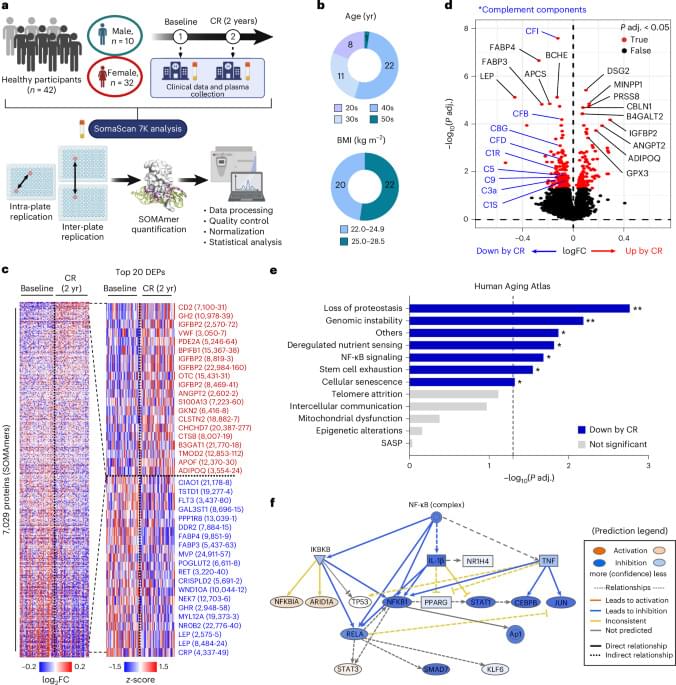
Calorie restriction (CR) extends healthspan across species, yet its translatable mechanisms have remained elusive. Profiling 7,000 plasma proteins from 42 participants of the two-year CALERIE trial (~11–14% CR), the Dixit lab at Yale identified complement component 3 (C3) as significantly downregulated by CR — strikingly, with no correlation to weight loss, suggesting an adipose-specific effect rather than a consequence of fat mass reduction. Mechanistic follow-up in mice overturned a canonical assumption: age-associated C3 elevation originates not primarily in the liver, but in aging-associated macrophage populations within visceral white adipose tissue, pinpointed via single-cell RNA sequencing. Pharmacological C3 inhibition recapitulated CR’s anti-inflammatory benefits in mice, framing complement deactivation as an immunometabolic checkpoint against inflammaging and a textbook case of antagonistic pleiotropy — youthful host defense turning into late-life tissue damage. The team is now exploring repurposed FDA-approved complement inhibitors as CR mimetics, with the central translational challenge being rebalancing, not suppressing, immune protection. Caveat: neither lifespan extension nor slowed human aging has yet been demonstrated.
Applying proteomics to longitudinal plasma samples from calorically restricted participants of the CALERIE trial, Mishra, Kim and colleagues link complement protein C3a to inflammaging. In aged mice, visceral fat macrophages produce C3a, and neutralization of C3a blocks inflammaging.