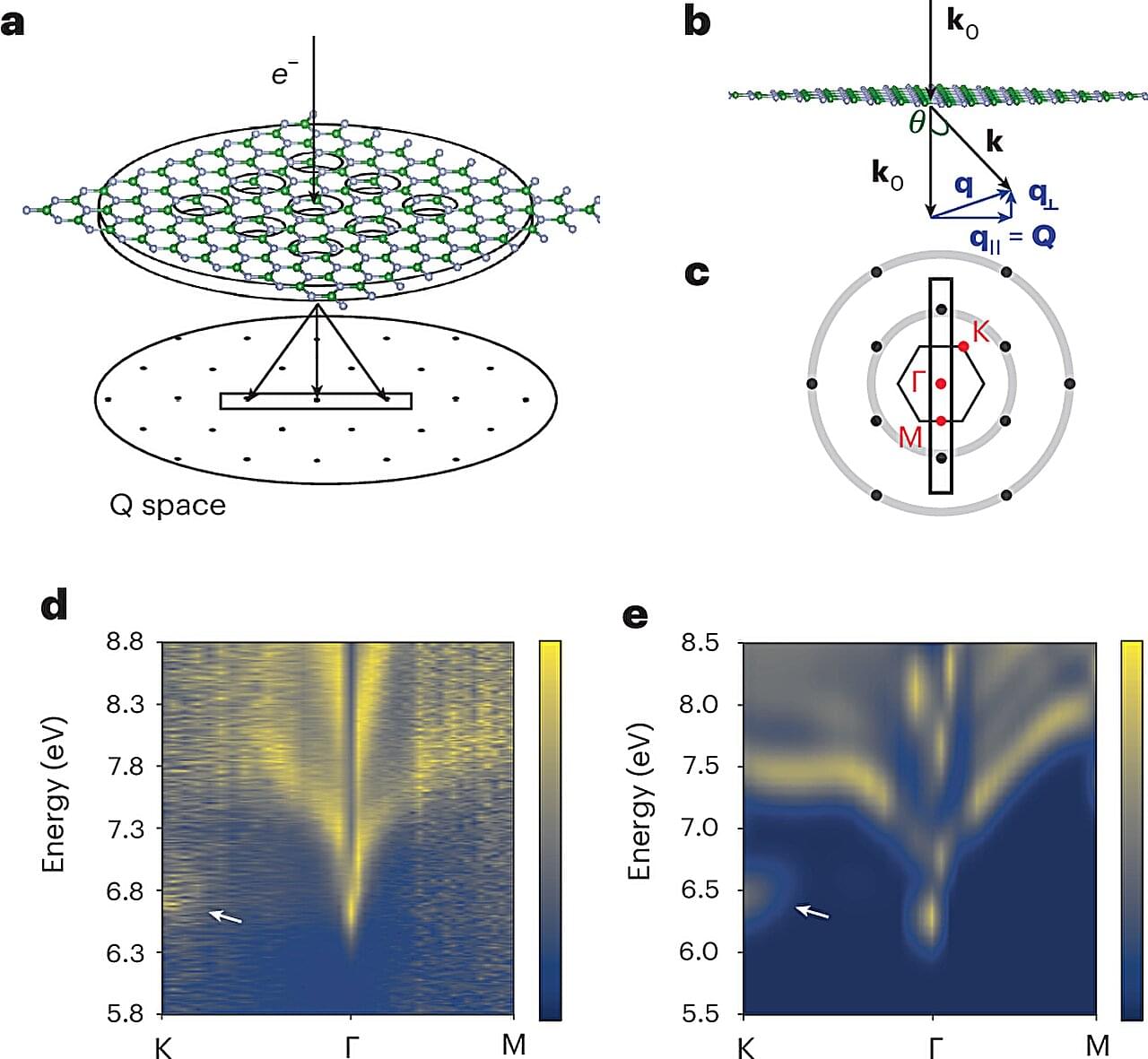
Combining their skills in theory and experiment, Yale researchers have observed for the first time a type of energy-carrying composite particle move in a highly unexpected way. It’s a finding that could lead to advances in quantum technologies, solar energy, LEDs and other optoelectronic technologies. The work is published in Nature Physics.
Ten years ago, Professor Diana Qiu made a bold prediction about excitons. These composite particles are created when light shines on a material, which excites an electron and causes it to move away from the atom’s nucleus, leaving in its absence what’s known as a hole. Because strange things happen in the quantum world, this hole then acts as a particle itself.
The negatively charged electron and positively charged hole attract each other and form a bound pair. Excitons are a critical component of next-generation solar cells and other technologies.