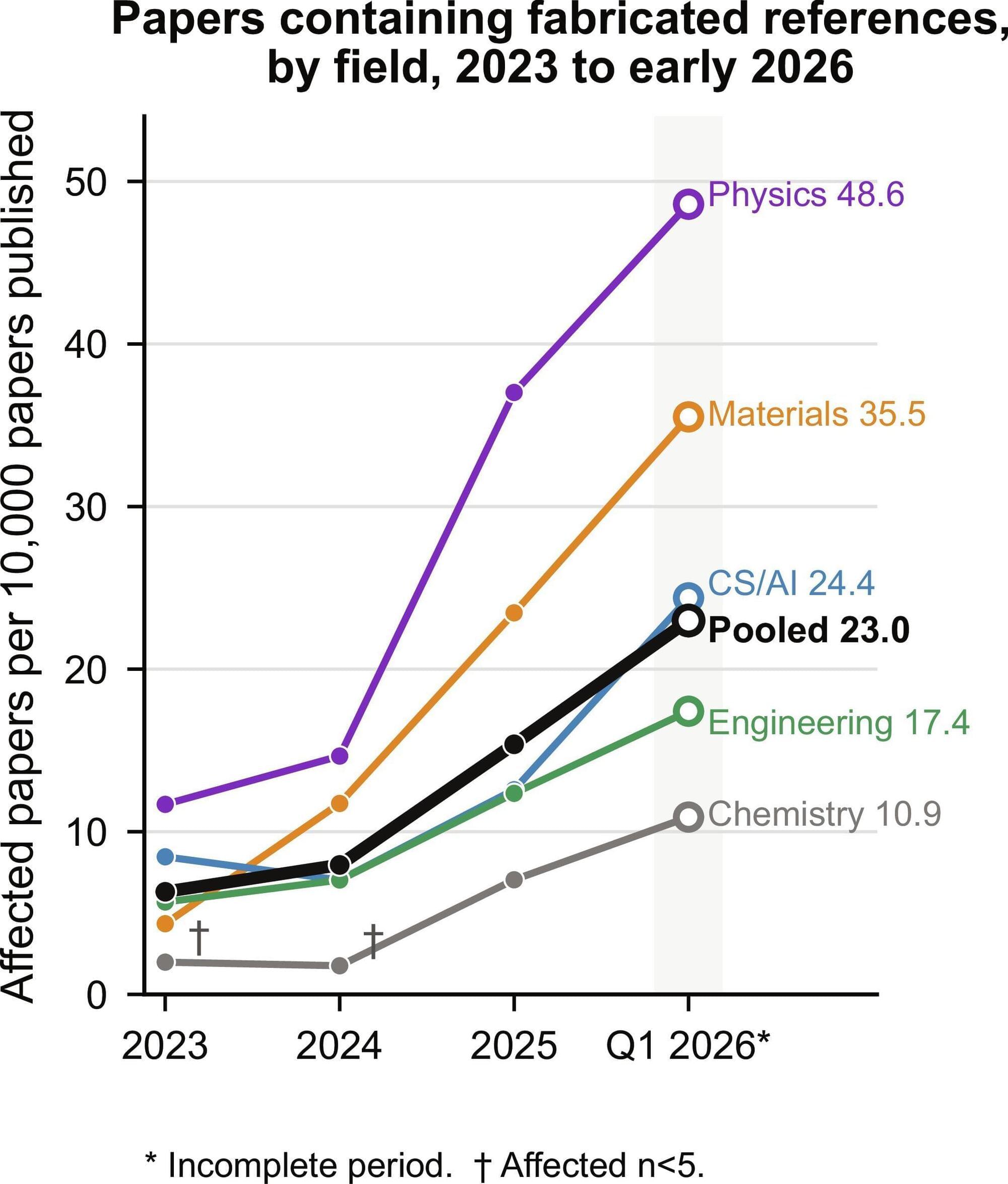
AI is creating fabrications in scientific papers.
A recent study published in PNAS (Proceedings of the National Academy of Sciences) and related scientific audits reveal a sharp rise in fabricated and hallucinated references in peer-reviewed literature driven by the uncritical use of artificial intelligence writing tools, paper mills, and publication misconduct.
Key Findings on Fabricated References.
• Rising Numbers: Audits of peer-reviewed journal papers show that fabricated references have increased dramatically (moving from roughly 1 in 1600 papers up to 1 in 435 science and engineering papers in recent tracking).
• Broad Impact: While initially flagged heavily in biomedical and clinical research, recent audits (including work highlighted via EurekAlert!) found suspected fake citations spanning physics, chemistry, engineering, and computing journals.
• How AI Hallucinates Citations: Large language models predict text based on statistical patterns rather than consulting a live database of facts. They frequently generate convincing-looking fake titles, scrambled authors, mismatched publication years, or fake DOIs.
• The “Real Paper, Wrong Claim” Risk: Some AI tools link to a real, existing paper, but misattribute or invent a claim that the actual source material never stated—a trap that is often harder to catch than a completely nonexistent citation.
• Human Responsibility: Academic publishers and ethics boards emphasize that human authors retain full responsibility for verifying every single citation, regardless of whether AI tools were used during drafting or literature discovery.
A random sample of 500,000 peer-reviewed journal papers found that fabricated references rose from 6.3 per 10,000 in 2023 to 23.0 per 10,000 in the first quarter of 2026 (with no signs of abating).
This is going to create a challenge for journals to catch these errors and hold authors accountable when they submit work with serious flaws.
https://www.pnas.org/doi/10.1073/pnas.
#ArtificialIntelligence #fabricatedreferences #scientificpapers
References to nonexistent studies are well documented in biomedical research, but evidence outside biomedicine is limited. We analyzed a stratified random sample of 500,000 peer-reviewed journal papers in chemistry, physics, materials science, engineering, and computer science published from January 2023 through March 31, 2026, using OpenAlex, a large open index of scholarly works and citations. Our automated pipeline classified 1,135 references across 619 papers as fabricated, with 85.8% precision on masked expert review; fabricated is an operational label for a claimed title that could not be located in any of seven bibliographic and open-web sources. Affected-paper prevalence rose from 1 in 1600 (6.3 per 10,000) in 2023 to 1 in 435 (23.0 per 10,000) in the first quarter of 2026, and full-period rates differed roughly sixfold across fields, from 25.6 per 10,000 papers in physics to 4.