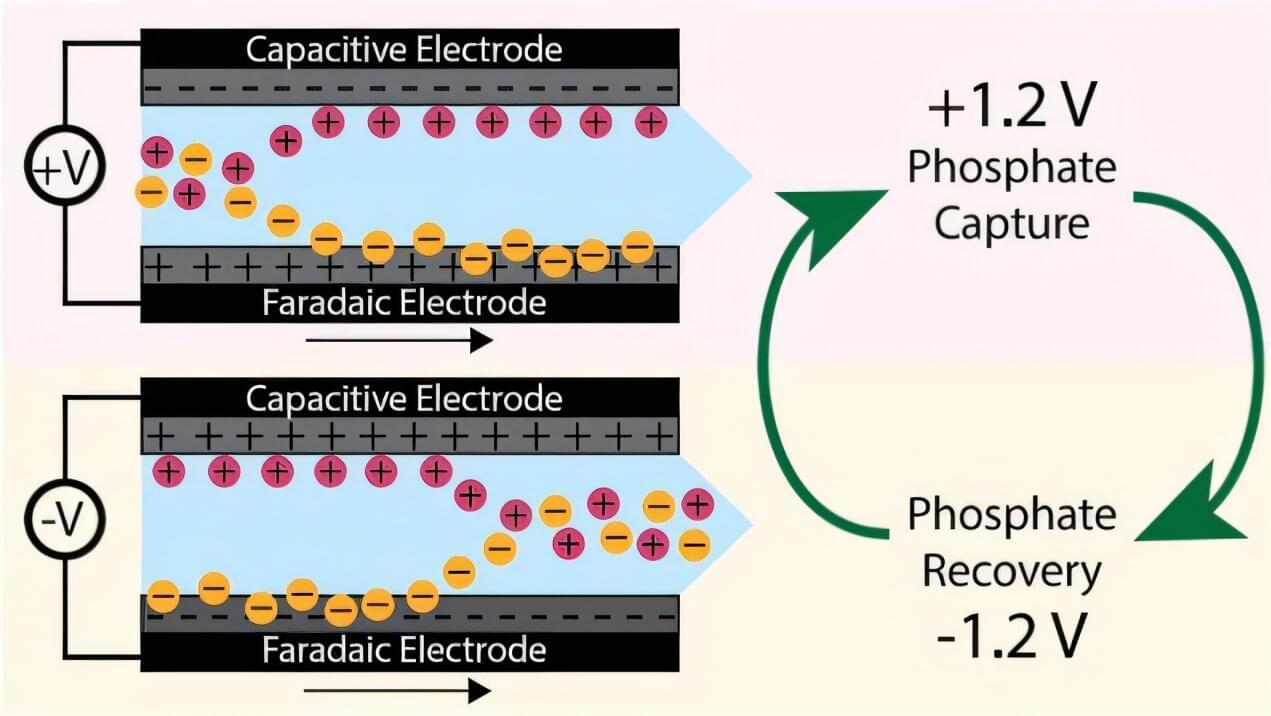
When rain falls on farmland, lawns and gardens, it can wash phosphate from fertilizers into nearby waterways, triggering harmful algal blooms that cloud lakes and rivers, release toxins and rob the water of oxygen needed to sustain aquatic life. Now, Northwestern University and Argonne National Laboratory researchers have developed a reusable electrode that captures phosphate from water in laboratory tests, potentially recovering a valuable, nonrenewable resource while reducing water pollution.
“Excess phosphate can fuel harmful algal blooms and leave waterways depleted of oxygen,” said Vinayak Dravid, a co-corresponding author of the study. “This approach uses electrons as a controllable switch to capture and release phosphate without adding chemical regenerants. Our larger vision is to recover valuable resources from contaminated water while minimizing chemical inputs and secondary waste.”
The electrode is made from carbon cloth coated with magnetite, a common iron oxide. Applying a positive voltage more than doubles the phosphate capture; reversing the voltage releases the captured phosphate for potential recovery and reuse. The research was published in ACS ES&T Engineering on Nov. 18.