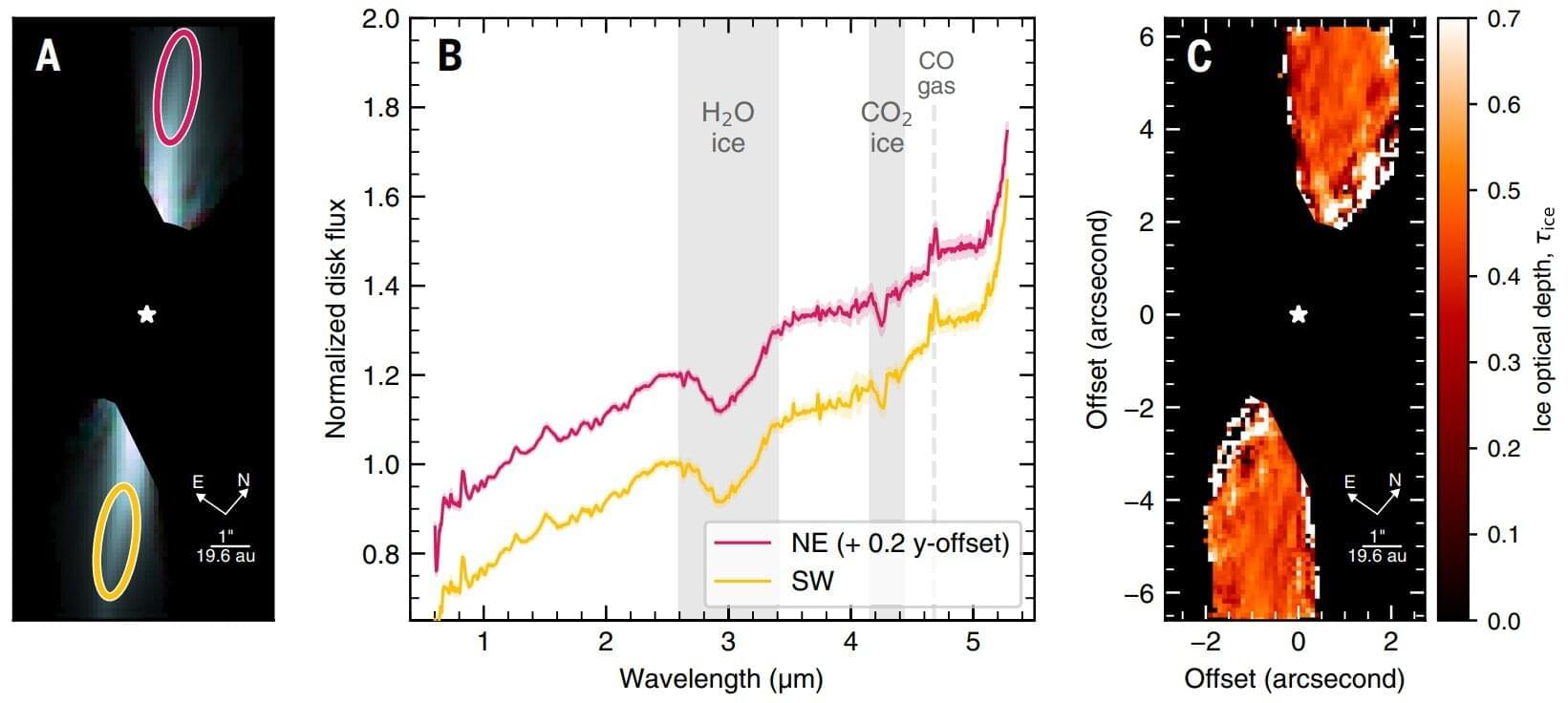
In a recent study of infrared light collected by the James Webb Space Telescope (JWST), a group of astronomers detected ice for the first time around the young star Beta Pictoris. Researchers had expected ice around Beta Pictoris, but previous searches had not directly detected it. The study, published in Science, found that the ice is mostly noncrystalline and mixed with carbon dioxide. The team says these new details provide clues about the early formation of the Beta Pictoris system and collisions that may still be occurring.
Beta Pictoris is a roughly 20-million-year-old star about 64 light-years away, surrounded by a dusty disk containing planets and smaller bodies. While an age of 20 million years may not sound young, our own solar system is around 4.6 billion years old. So, Beta Pictoris’ system is still stabilizing and forming smaller bodies within its dusty disk. So far, however, astronomers have identified three larger planets in the system, one of which was discovered earlier this year.
Earlier observations around Beta Pictoris found carbon monoxide gas, although sunlight should have destroyed it within around 50 to 300 years, a short time on the cosmic scale. The researchers say that the presence of carbon monoxide gas might mean it was recently released from collisions involving solid ice, potentially from volatile-rich comets or planetesimals. Yet, no studies had previously found evidence of the ice. For pure ice, that made sense. Models suggested that pure ice grains would disappear rapidly under the conditions in the disk, but ice mixed with other materials could survive longer.