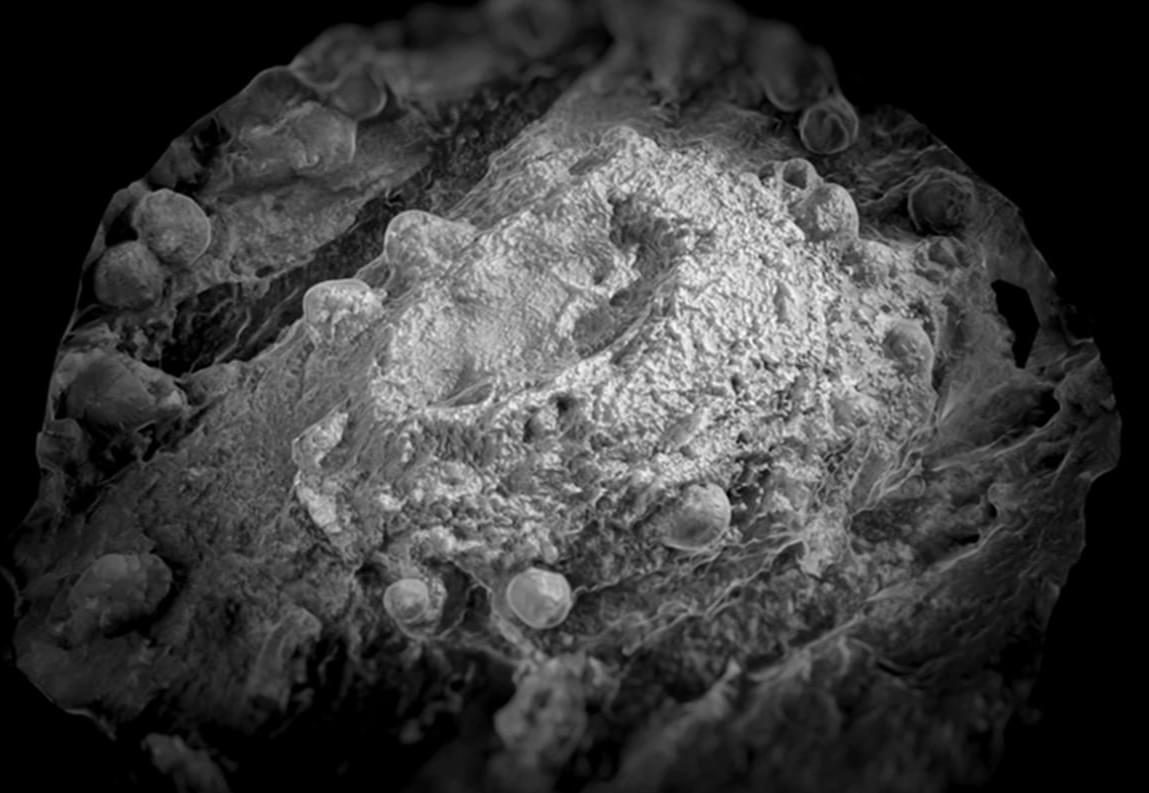
Blood cells don’t fossilize very easily. Most break down shortly after death, and certain minerals can mimic the blobby shape of cells under a microscope, making the prospect of finding convincing traces of very ancient blood—say, as old as dinosaurs—far-fetched. Yet that’s what scientists say they’ve uncovered in a paper published today in the Proceedings of the National Academy of Sciences. With multiple lines of evidence, the international team behind the new study claims the remains from a 115-million-year-old dinosaur from Brazil contain the oldest fossilized red blood cells ever discovered. But some experts remain skeptical.
“It’s probably the most comprehensive effort that’s been done so far,” says Maria McNamara, a paleobiologist at University College Cork who was not involved in the new work. But, she adds, “I would be very cautious about interpreting those necessarily as red blood cells.”
For decades, researchers have tried to find irrefutable evidence of dinosaur blood in fossils. Finding and characterizing blood cells from dinosaurs could help paleontologists learn more about how they adapted to their environments, says Mary Schweitzer, a paleontologist at North Carolina State University who in 2005 claimed to have found blood vessels and red blood cell–like structures in a Tyrannosaurus rex bone, but who wasn’t involved in the new study. At least 14 studies have attempted to describe red blood cells found in dinosaur and other very old fossils before. But such claims must rule out contamination and look-alikes, and none of these previous studies has broadly convinced other experts in the field.