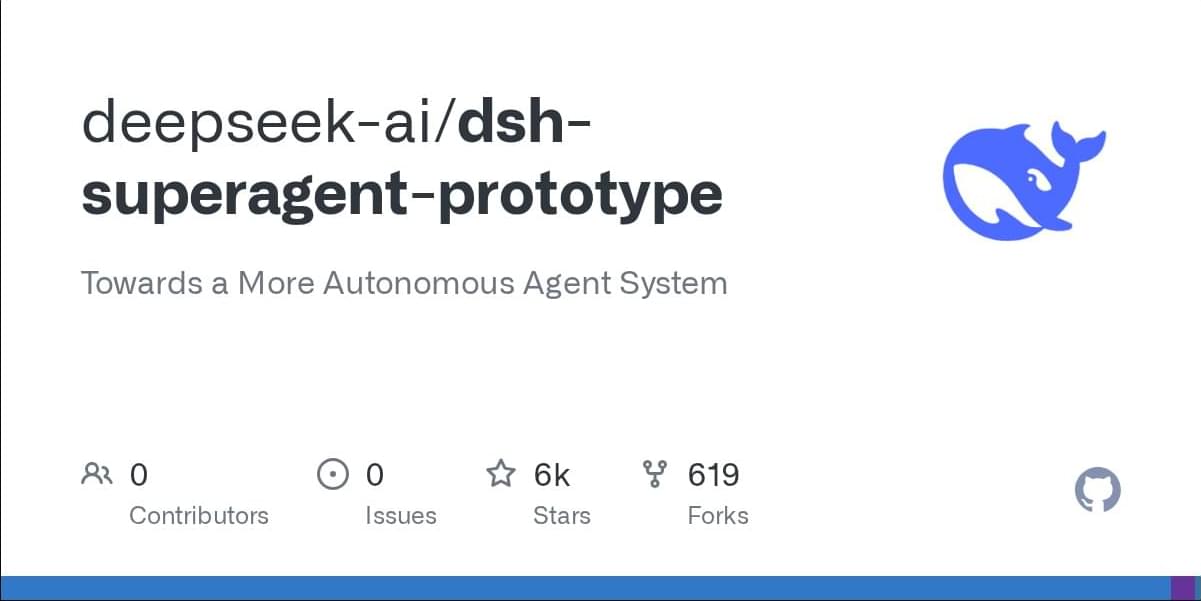
DeepSeek launches “Super-Agent,” a new open-source AI coding agent designed to rival Anthropic’s Claude Code.
DeepSeek’s Super-Agent is an open-source, always-on AI coding agent architecture released by DeepSeek’s Harness team on GitHub under the MIT license.
Positioned as an autonomous alternative to tools like Anthropic’s Claude Code, Super-Agent shifts the focus from model capability to solving human attention limits in software development.
Key Architecture: Two-Layer “Router & Worker”
Traditional terminal or single-session AI coding tools require constant human monitoring and prompt management. DeepSeek’s Super-Agent breaks this paradigm using a two-tier system:
1. The Router (The Triage Layer): An always-on, lightweight agent that monitors group chats (Slack, WeChat), GitHub pull requests, and CI/CD pipelines. It handles initial entry points, prioritizes triggers, and delegates work without executing shell commands itself.
2. Workers (Isolated Execution Sessions): Spun off by the Router, individual Workers use full-capability LLMs and shell toolsets to execute specific coding tasks in parallel.
3. The Watchdog: An autonomous monitoring session running on a timer that tracks active Workers, ensuring tasks don’t stall or get stuck in infinite loops.
Super-Agent vs. Claude Code.
Feature anthropic claude code deepseek super-agent.
Primary Interface Terminal-first interactive CLI Always-on background agent across Slack, GitHub, & CLI
Execution Trigger Human-driven ‘@‘ mentions or terminal commands Proactive event-driven monitoring + @ mentions.
Task Delegation Single-session with subagent delegation capability Decoupled Router layer dispatching multiple isolated parallel workers.
License Proprietary product / CLI Open-source (MIT License) research prototype Core Capabilities & Performance.
Notes:
The operational difference between DeepSeek Super-Agent and Anthropic’s Claude Codecomes down to asynchronous, event-driven autonomy versus synchronous, command-line collaboration.
While both serve as AI software engineering tools, they reframe the developer’s role in the development workflow completely.
1. Triggering & Initiation.
* Claude Code (Developer-Driven): Workflow starts inside the local terminal. The developer opens a repository, types ‘claude‘, and passes instructions via an interactive CLI prompt. Execution is synchronous—the developer gives a directive, watches the agent work through terminal actions, and responds to interactive prompts or permission requests.
* DeepSeek Super-Agent (Event-Driven): Workflow runs as a background process or service. The Router continually listens to passive event streams—CI/CD build failures, GitHub PR comments, Slack bug channels, or local file watches. The developer does not need to open a session; the agent triggers itself upon detecting work.
2. Session Context & Multi-Tasking.
* Claude Code (Single-Session Focal Point): Designed around deep focus on a single repo or active feature branch. While Claude Code can spawn sub-agents to complete focused sub-tasks internally, human attention remains locked to that single terminal session until completion.
* DeepSeek Super-Agent (Parallelized Task Swarms): Designed around task parallelism. The Router receives multiple inbound issues, instantiates isolated Worker sessions for each issue, and manages them in parallel. A developer can have 5 pull requests being patched simultaneously across multiple repos without maintaining 5 open terminal windows.
3. Human Control & Safety Gateways.
Claude Code Workflow:
DeepSeek Super-Agent Workflow:
* Claude Code Permissions: Operates using direct, granular permission prompts right in the CLI session. You approve file edits, shell execution commands, or external network requests step-by-step as they happen.
* DeepSeek Super-Agent Permissions: Uses Observe Mode and automated gatekeeping. Instead of inline interactive prompts, Workers perform work autonomously in isolated sandboxes. In ‘observe‘ mode, the agent prepares the entire solution, logs what shell actions it would execute, and opens a GitHub Draft PR or Slack summary for review before touch-applying to the base branch.
4. Environment & Execution Boundary.
* Claude Code: Runs strictly where the terminal process is executed. Environment variables, local shell tooling, and local file access are bound directly to the workstation or container where the CLI binary is invoked.
* DeepSeek Super-Agent: Uses a decoupled infrastructure:
* Router Layer: Cloud-hosted or daemon-hosted long-running service monitoring team channels/webhooks.
* Execution Workers: Ephemeral local or containerized daemons that spawn only when assigned a task, pull down relevant context, run tests, and tear themselves down upon submission.
Direct Workflow Comparison.
Workflow stage anthropic claude code deepseek super-agent.
Primary Workstation Setup Terminal / Local CLI environment Service daemon + Chat/Git integration.
User Prompting Style Direct interactive chatting & command execution Passive issue creation, Slack tagging, or PR alerts.
Execution Paradigm Synchronous, step-by-step assistant Asynchronous, decoupled task worker.
Handling Interruption Pauses and waits for terminal user input Monitored by internal Watchdog daemon to handle stalls.
Best Used For Active feature engineering, interactive refactoring Continuous triage, automated bug patching, CI repair.
Core Capabilities & Performance.
* Proactive Monitoring: Super-Agent can read ongoing developer chats, detect bug reports or technical discussions, and offer fixes or code branches before being explicitly tagged.
* Speed & Task Scheduling: In synthetic benchmark tests published by DeepSeek, Super-Agent completed tasks with a 95th-percentile (p95) time of 15.7 minutes, compared to 29.5 minutes for traditional single-session subagent approaches.
* Observe Mode Safety: To prevent unwanted autonomous changes, the architecture introduces explicit permission tiers: ‘off‘, ‘observe‘ (where the agent logs what actions it *would* have taken), and ‘auto‘.
* Local/Cloud Decoupling: The orchestration loop runs persistently in the cloud, while a lightweight local daemon executes terminal actions on your local machine only when needed.
Current Status: DeepSeek emphasizes that is a research prototype rather than a fully polished end-user product. Security models, long-term memory, and human intervention controls remain active areas of refinement before widespread production deployment.
#ArtificialIntelligence #DeepSeek #AIAgents #opensource
Towards a More Autonomous Agent System. Contribute to deepseek-ai/dsh-superagent-prototype development by creating an account on GitHub.