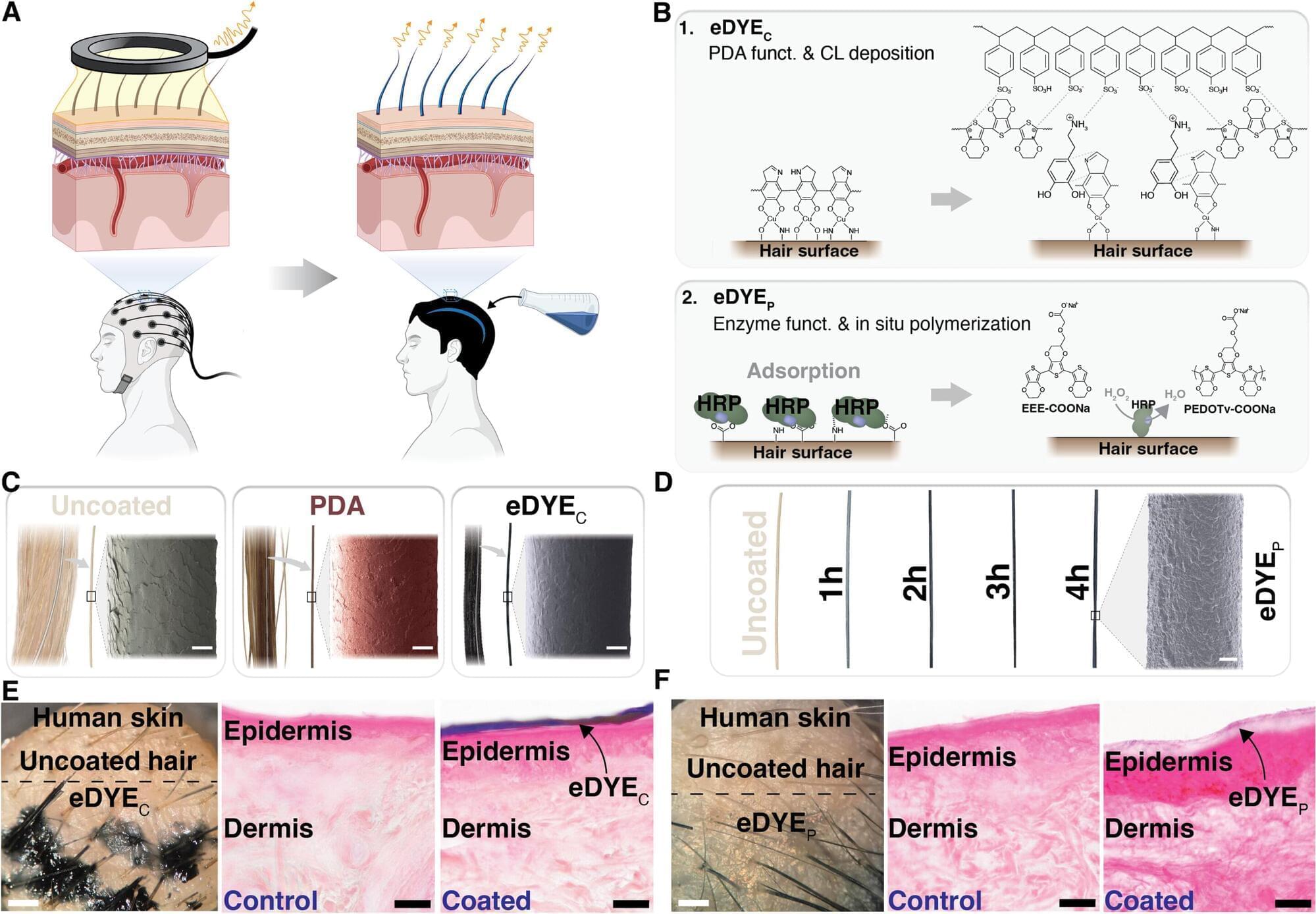
When doctors want to record the brain’s electrical activity, they place electrodes on a person’s scalp. However, hair can get in the way, making it harder for the electrodes to pick up clear signals. But that could soon be a thing of the past. A team of scientists has developed hair dyes that turn hair into EEG (electroencephalography) electrodes. They call the resulting electronic hair “eHAIR.”
The researchers concocted two recipes based on conductive polymers, which are materials used to create electronic devices that interact with biological tissues.
The first contains a conductive polymer called PEDOT: PSS. To help it stick to the hair, strands are first treated with polydopamine, which acts as a glue. The result is a continuous coating that can extend down to the scalp.