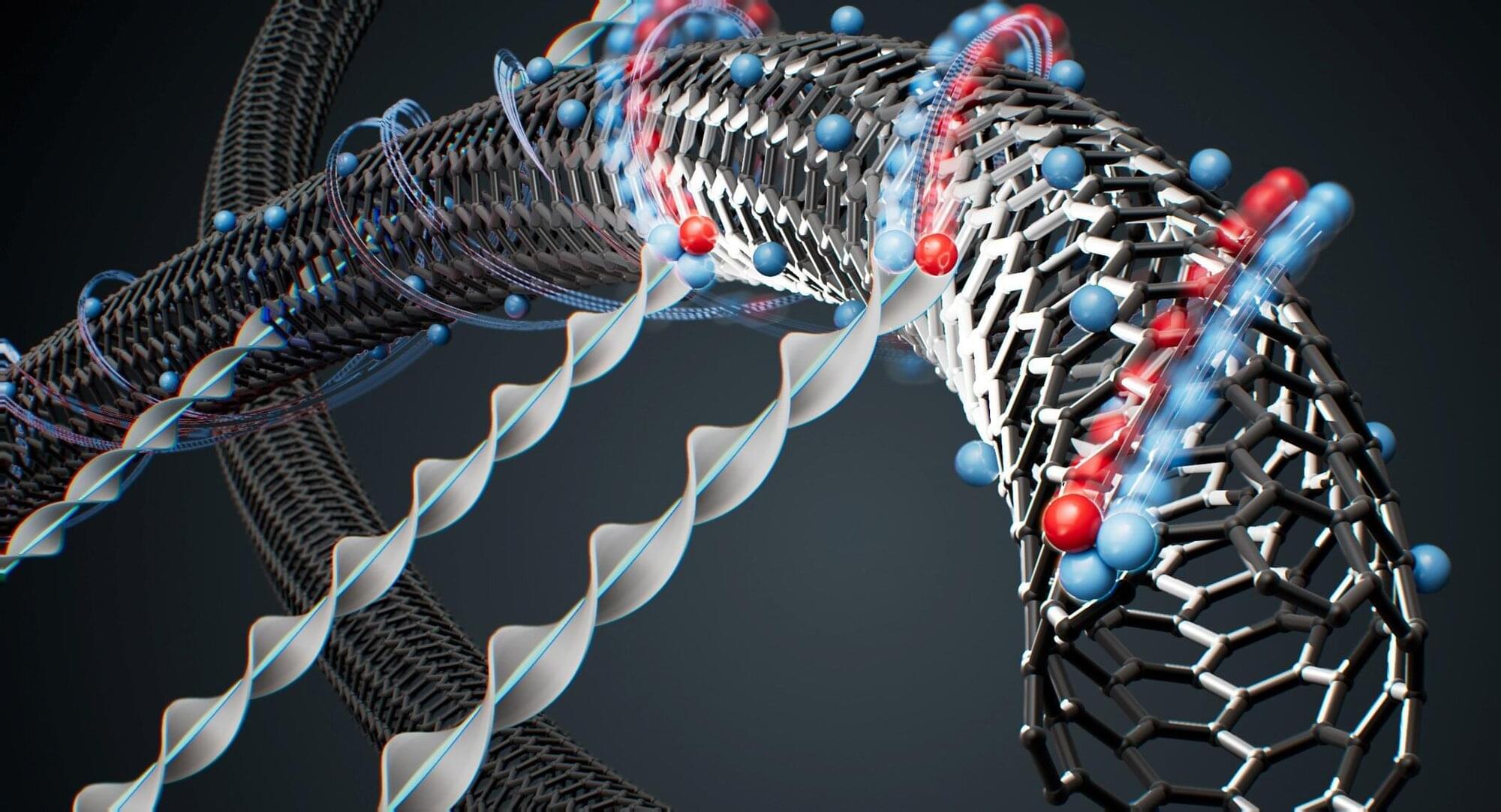
Scientists from Tokyo Metropolitan University have discovered that charged states made of two electrons and a positively charged hole (or vice versa) on atomically thin rolls of carbon atoms have a structure-derived “handedness” in how they interact with light. While electron-hole pairs, or “excitons,” were known to keep the chirality of the underlying nanotube, the team showed that adding a charge to create “trions” does not change this property.
Their work, published in the journal Nature Communications, highlights new ways in which carbon nanotubes might be used in next-gen optoelectronic devices.
Chirality is a fascinating feature of the material world. Whether it be a circular staircase, a wrung towel, double-stranded DNA or pharmaceutical molecules, an object can often have a “handedness” which means that its mirror image can never be matched to the original.