For centuries, we thought we understood magnets. But hidden inside a newly discovered class of magnetic materials is a twisting, invisible wave that could rewrite the rules of future technology.
The Discovery of the “Twisting” Magnetic Wave.
We are all familiar with everyday magnets, but physicists have recently identified a fascinating new class of magnetic materials called altermagnets. These materials act as a bridge, blending the familiar properties of standard magnets with the hidden, complex patterns of antiferromagnets.
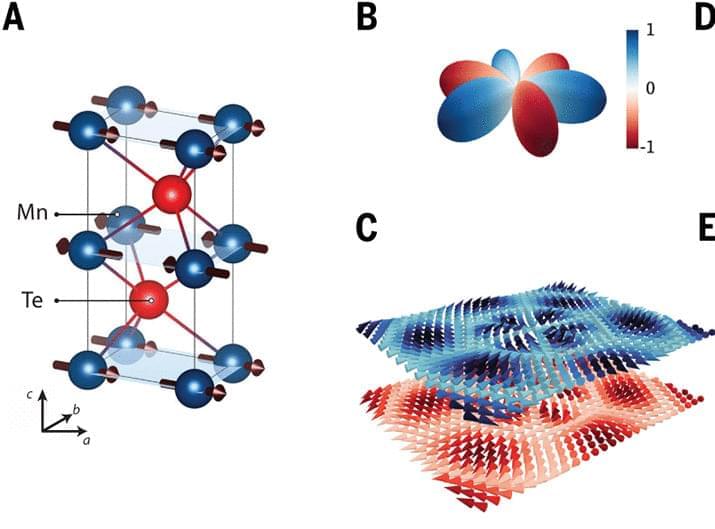
Theoretical physicists predicted that inside altermagnets, magnetic energy travels in waves (known as “magnons”) that possess a specific “handedness.” Just as your left and right hands are mirror images but cannot be perfectly overlapped, these magnetic waves twist in distinct left-or right-handed directions—a property scientists call *chirality*.
Now, researchers have captured the first direct experimental proof of this phenomenon. Focusing on a well-known altermagnet candidate called manganese telluride (MnTe), scientists fired specially twisted X-ray light (circularly polarized light) at the material to stir up its magnetic waves. They observed that the material’s response changed depending on whether the light was twisted to the left or to the right. This proved that the magnetic waves themselves carry a distinct, directional twist. The team has officially named this newly verified phenomenon the “chiral altermagnon.”
This discovery is more than just a neat physics trick; it confirms a major theoretical prediction about how this new state of magnetism works at a fundamental level. By proving that these twisting magnetic waves exist and understanding how they behave, scientists have opened a new door for future technology.
Controlling these waves could eventually lead to breakthroughs in spintronics (ultra-fast, highly energy-efficient electronics that use magnetic “spin” instead of electrical charge to process information) and the development of advanced quantum computers.
In short, by catching a “twisting” magnetic wave in the act, scientists have taken a significant step toward the next generation of computing and technology.
#physics #altermagnets #Spintronics #QuantumComputing #quantumphysics
Altermagnetism has been recognized as a magnetic phase that bridges the properties of ferro-and antiferromagnetism. The momentum-dependent spin splitting observed in these materials reflects their distinctive symmetry characteristics, which also establish the conditions for chiral magnons to emerge. Here we provide direct experimental evidence for a chiral magnon in the altermagnetic candidate manganese telluride (MnTe) revealed by circular-dichroism resonant inelastic x-ray scattering. This mode, which we term chiral altermagnon, exhibits a distinct momentum dependence of its spin polarization consistent with the altermagnetic g-wave symmetry of MnTe. Our polarization-resolved data corroborate the existence of a discrete class of magnetic excitations, demonstrating how altermagnetic order shapes spin dynamics and paving the way for advances in spintronic and quantum technologies.