A UCLA-developed technology that is like a test tube but on the cellular scale has led to a number of biomedical discoveries in recent years, including revelations about cancer, heart disease and the genetic levers that push cells to release proteins.
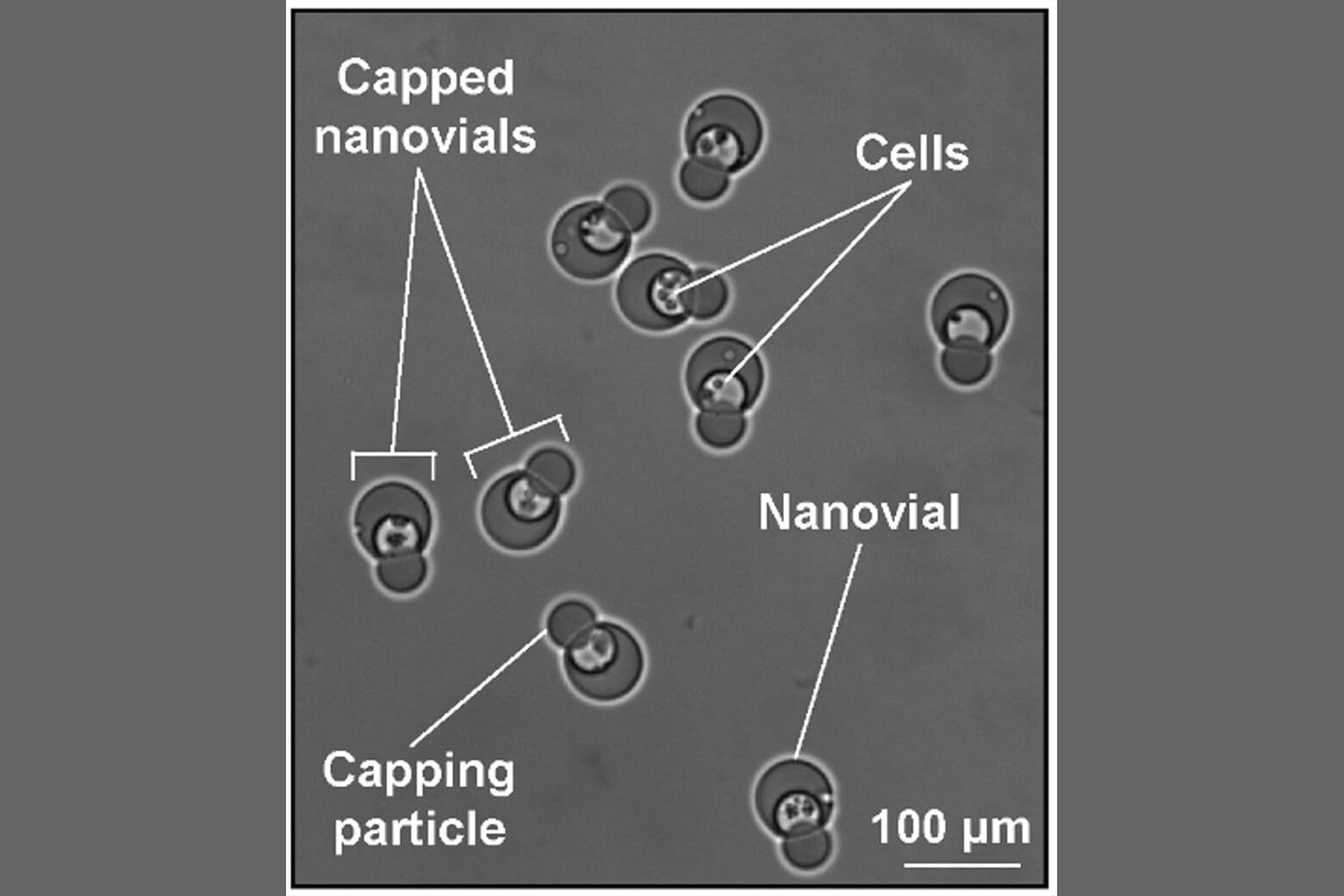
Imagine shrinking a test tube until it can hold just one or two cells, then making hundreds of thousands of these miniature test tubes to run experiments simultaneously. That’s the idea behind UCLA’s nanovial technology, which uses tiny bowl-shaped hydrogel particles to capture cells and measure what they produce. Now, researchers have added a lid, allowing cells to remain inside longer, grow into small colonies and interact with other cells under controlled conditions.
A new study published in Science Advances demonstrated that capped nanovials can be used to collect and sort cells, including bacteria and yeast that were difficult to capture in uncapped nanovials. By confining cells for longer, the capped nanovials enabled researchers to grow cells inside of them and select for the fastest-growing colonies. Profiling interactions between cells, the team used capped nanovials to confirm that one cell changed the behavior of another.