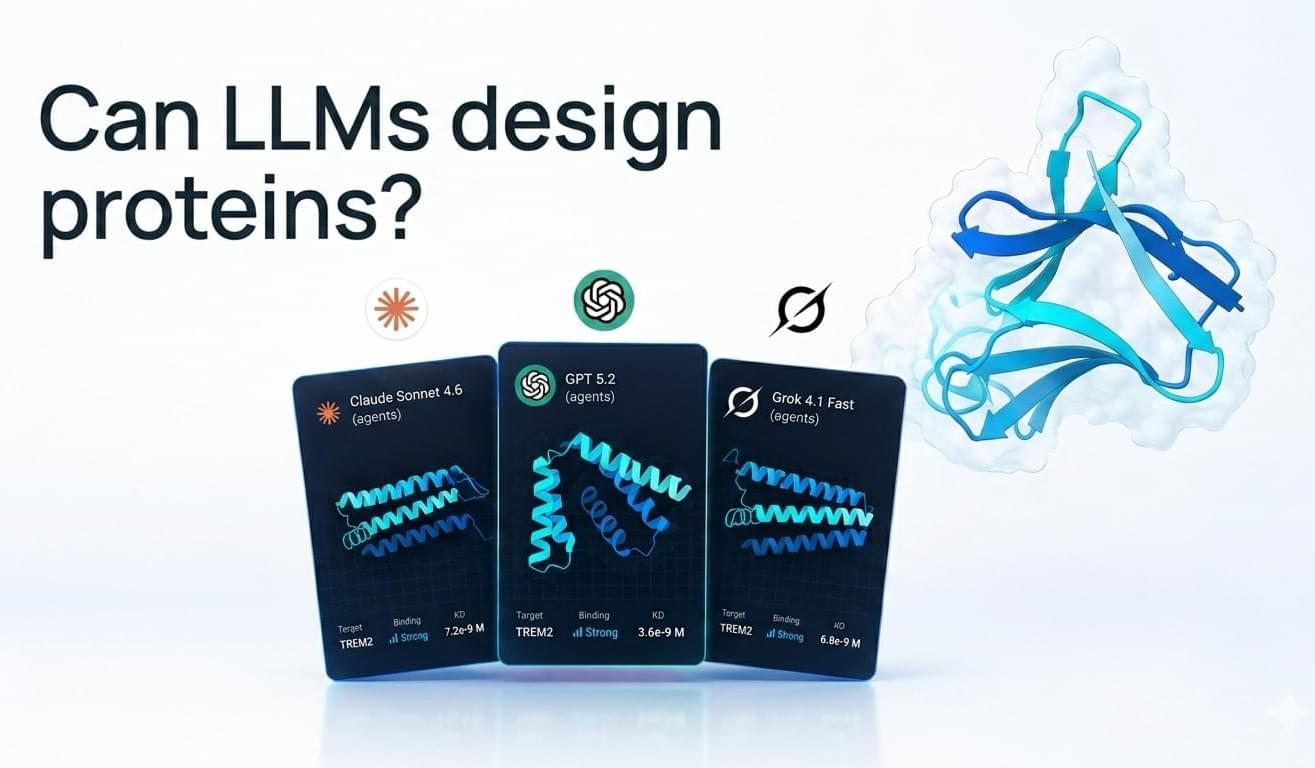
In the “muni × Adaptyv TREM2 hackathon”, human teams competed against LLMs to use AI protein design tools to create protein binders against the medically relevant target TREM2. Remarkably, the result was a tie between human teams and LLM agents.
I am optimistic that the emergence of automated AI protein design may actually free human protein engineers to explore creative ‘weird’ directions with the power of these tools at our disposal.
Note: these results were posted back in May 2026.
… or how AI agents tied 10 human teams at designing TREM2 binders.
After a busy few weeks of binding assays, we’re ready to release the results from the muni × Adaptyv TREM2 hackathon, in which 10 human teams and 6 fully autonomous AI (LLM) agents working end-to-end on muni’s platform designed binders against TREM2, a target implicated in Alzheimer’s disease. This took place in San Francisco, in a single day. Participants contributed 141 designs in total, with the top 100 by Boltz-2 ipSAE going to the wet lab. Today, all results are live on Proteinbase. We will further showcase some interesting findings throughout this hackathon and, of course, tell you which team (humans or agents) won it. Or, even more surprising, that both teams in fact tied.
muni is the platform the agent teams ran on, a sandboxed environment in which an AI agent gets a target sequence, budget, and tool access. It is then expected to design proteins without a human supervising it. First, let’s define what an (LLM) “Agent” is: it means a state-of-the-art language model (think ChatGPT or Claude), with access to tools (via a Model Context Protocol or MCP), with a single starting prompt. In this hackathon, the agent picked the tools, built a pipeline, ranked its own outputs, and submitted the final 10, which is to say it does not mean “an LLM was asked to randomly generate 10 sequences”. All agents ran autonomously on muni.