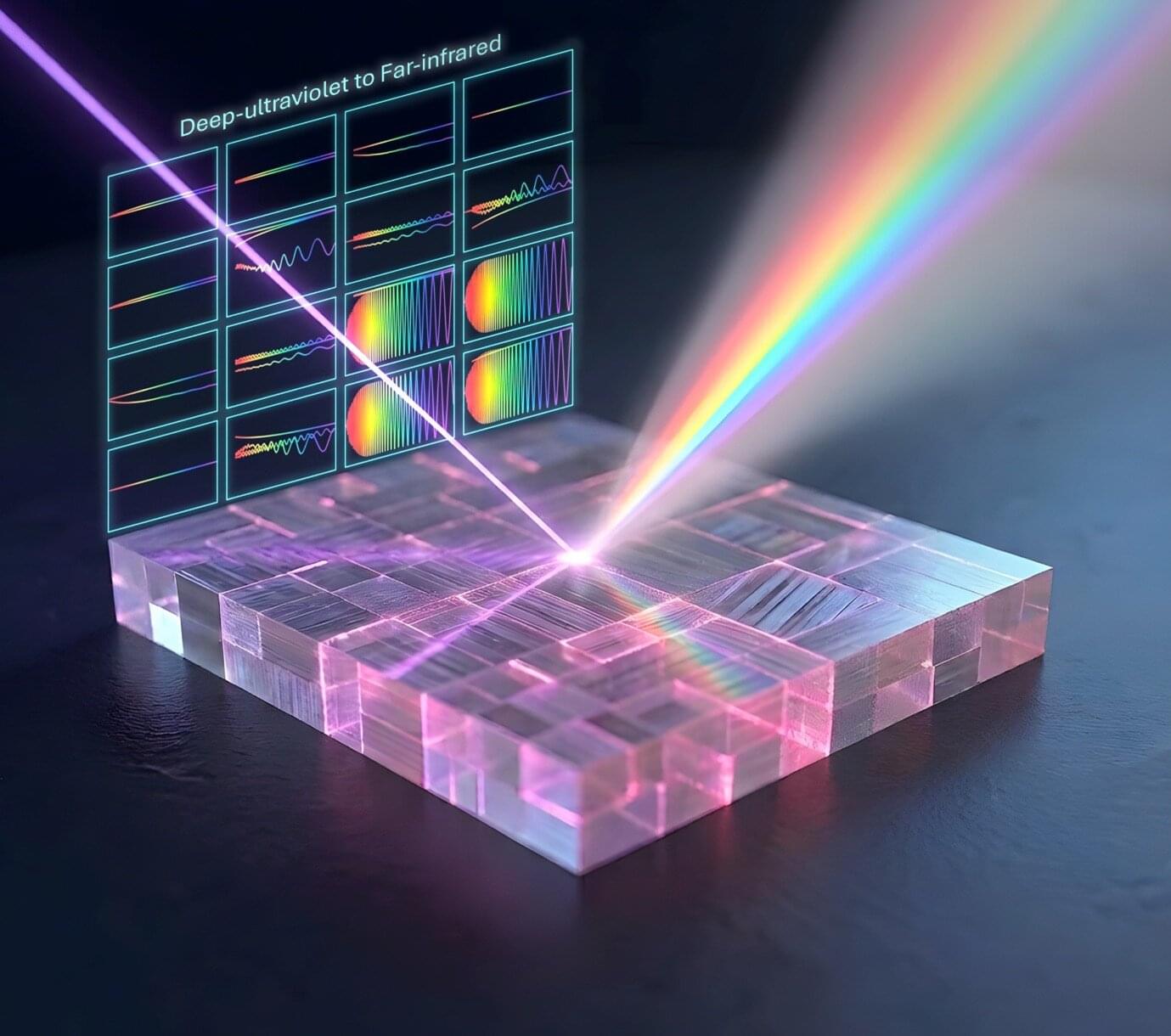
A KAIST-led research team has characterized how light propagates through and is absorbed by barium titanate (BTO), a promising material for next-generation optical communication devices. By clarifying optical properties that had been difficult to determine because of the material’s complex internal structure, the study provides a foundation for designing these devices.
The research team led by professor Min Seok Jang of its School of Electrical Engineering had precisely characterized BTO’s refractive index and absorption properties across wavelengths ranging from the ultraviolet to the far-infrared. The study was conducted in collaboration with professor Harry A. Atwater’s team at the California Institute of Technology (Caltech), the Korea Research Institute of Standards and Science (KRISS) and U.S.-based J.A. Woollam Co. The work is published in ACS Photonics.
BTO’s refractive index changes when an electric field is applied. Its strong electro-optic response, known as the Pockels effect, makes it a promising material for optical modulators, which encode information from electrical signals onto light.