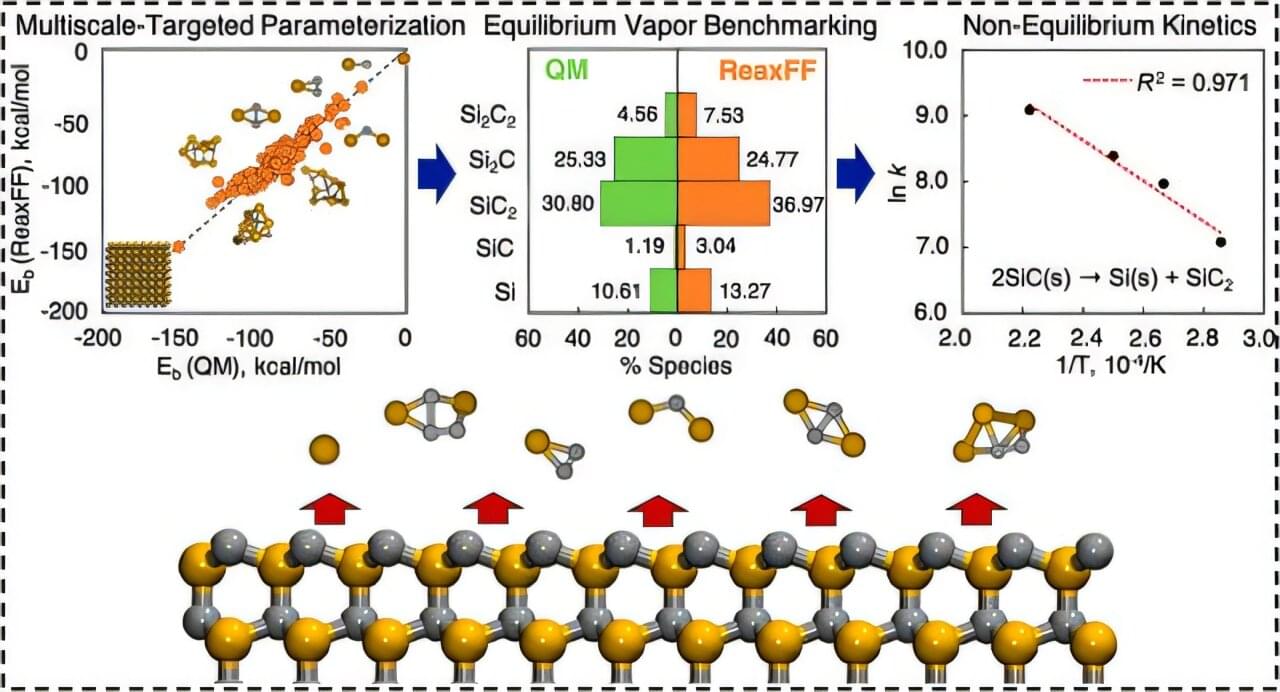
Penn State researchers have refined an atom-scale model of how silicon carbide changes from a solid into vapor during crystal growth, work that could help manufacturers produce higher-quality material for advanced electronics while reducing costly trial-and-error experiments.
The study, published in The Journal of Physical Chemistry C, is the first publication from Penn State’s Silicon Carbide Innovation Alliance, or SCIA, an industry-university research partnership.
Silicon carbide (SiC) is a crystalline material used in high-power electronics, including electric vehicles and clean-energy systems. As opposed to other crystals, which can be grown by melting the material and then cooling it into a solid, silicon carbide is grown using physical vapor transport (PVT). In this process, solid silicon carbide is heated until it turns directly into vapor, which then settles onto a seed crystal and builds a larger crystal.