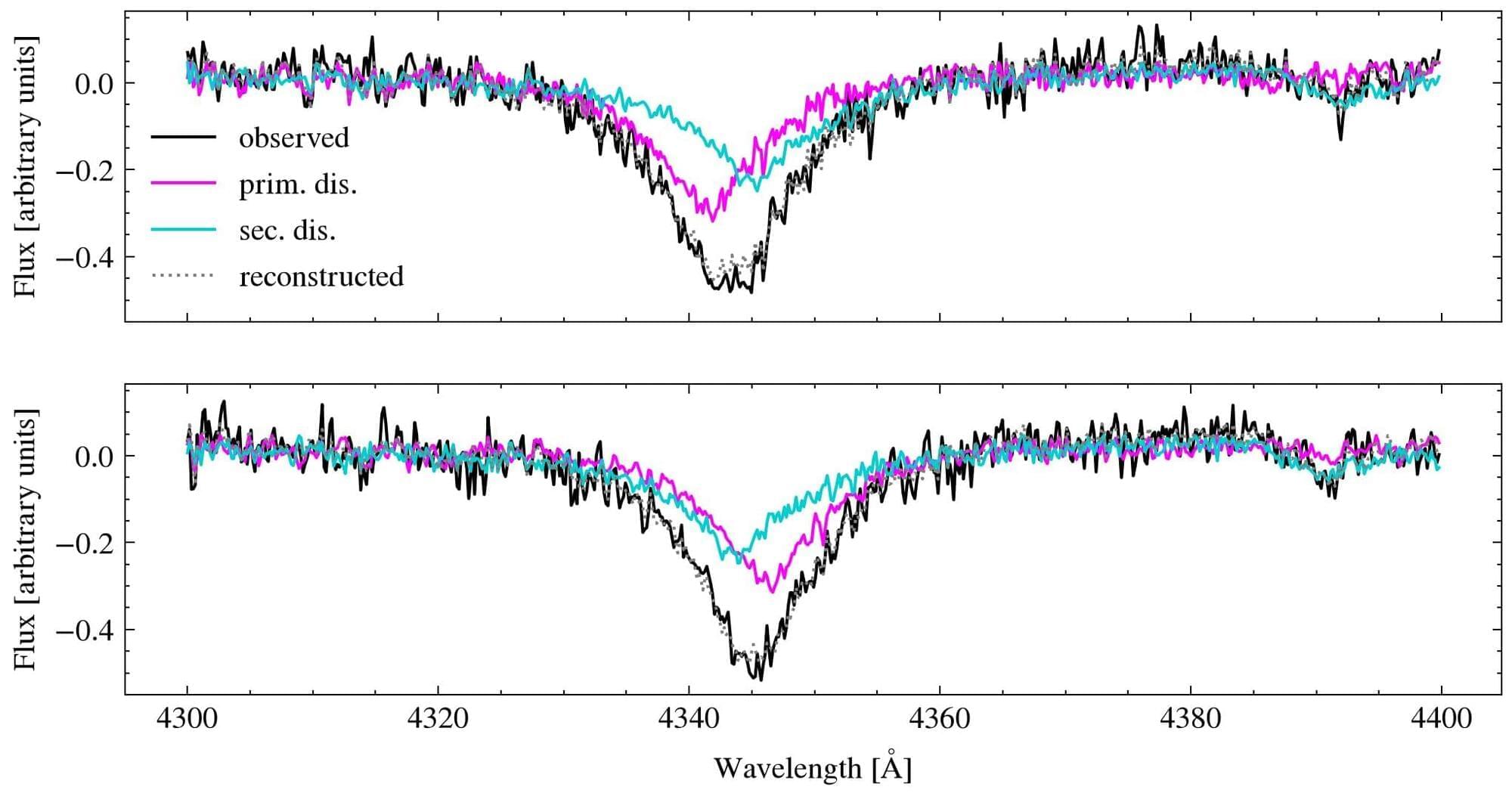
Sometimes massive stars can mimic the behavior of a black hole and trick astronomers into misinterpreting their nature. Such is the case with a strange pair of stars in the Large Magellanic Cloud (LMC) cluster NGC 1850. The system was initially thought to contain a star about five times the mass of the sun orbiting a stellar-mass black hole. Now, a new study led by Rhys Seeburger of Liverpool John Moores University demonstrates that this is a black hole “impostor” system. The research paper was posted to the arXiv preprint server on Oct. 27.
It is common for massive stars to be born and live in binary systems. When one star runs out of fuel and explodes, the resulting neutron star or black hole remains in the binary system with its companion. If the dead star’s remnant is a black hole and it barely emits any X-rays, it is called a dormant black hole. Such systems are hard to find because the only way they can be found is through the black hole’s effect on the visible star’s motion.
Models predict around 100,000 such systems in our galaxy. Only a few dormant black holes are confirmed, including VFTS 243 in the LMC and HD 130,298 in the Milky Way. But pairs of ordinary stars can also mimic the signal, especially after mass transfer leaves one star stripped and bloated, which can outshine its companion. So, these impostor systems can infiltrate the sample.