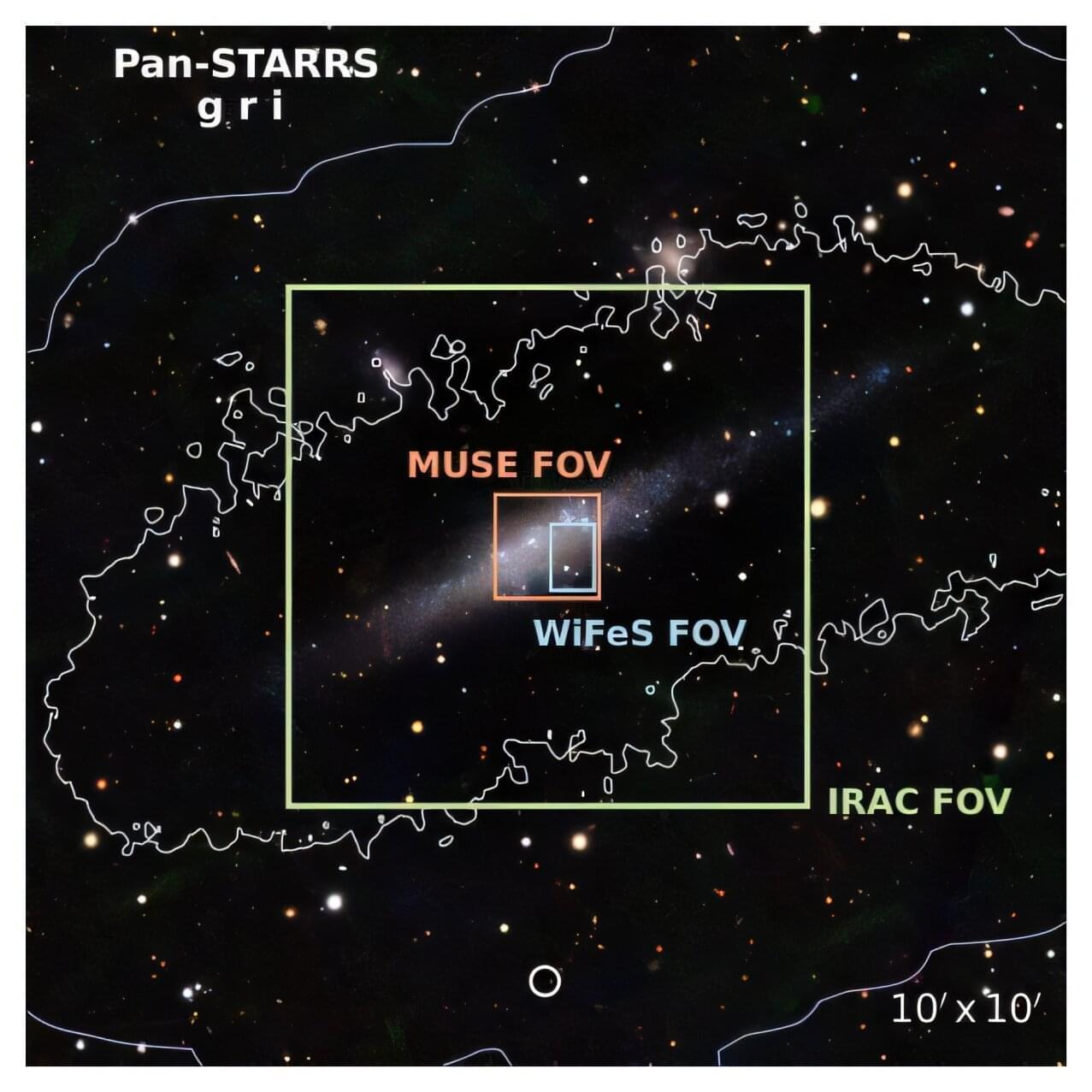
New findings show that a nearby dwarf galaxy, UGCA 320, may challenge some predictions of the widely accepted cosmological model of the universe. By combining observations from the MUSE instrument with radio measurements from the MeerKAT telescope, astronomers have found that it hosts an unusually large dark matter core. The paper was posted to the arXiv preprint server on Nov. 11.
The standard cosmological model, called Lambda Cold Dark Matter, predicts that dark matter accumulates in a sharp “cusp” at a galaxy’s center. Its density rises sharply toward the center. But observations of small galaxies have shown a flat, smooth “core” instead. This mismatch is called the cusp-core problem.
To address this problem, instead of “cold” dark matter, which moves slowly and interacts through gravity, various alternative dark matter candidates have been put forward. They are warm dark matter, self-interacting dark matter and fuzzy dark matter. There’s also another explanation involving ordinary matter, which says that repeated bursts of star formation and supernovae can churn up the center and push dark matter outward, flattening the cusp.