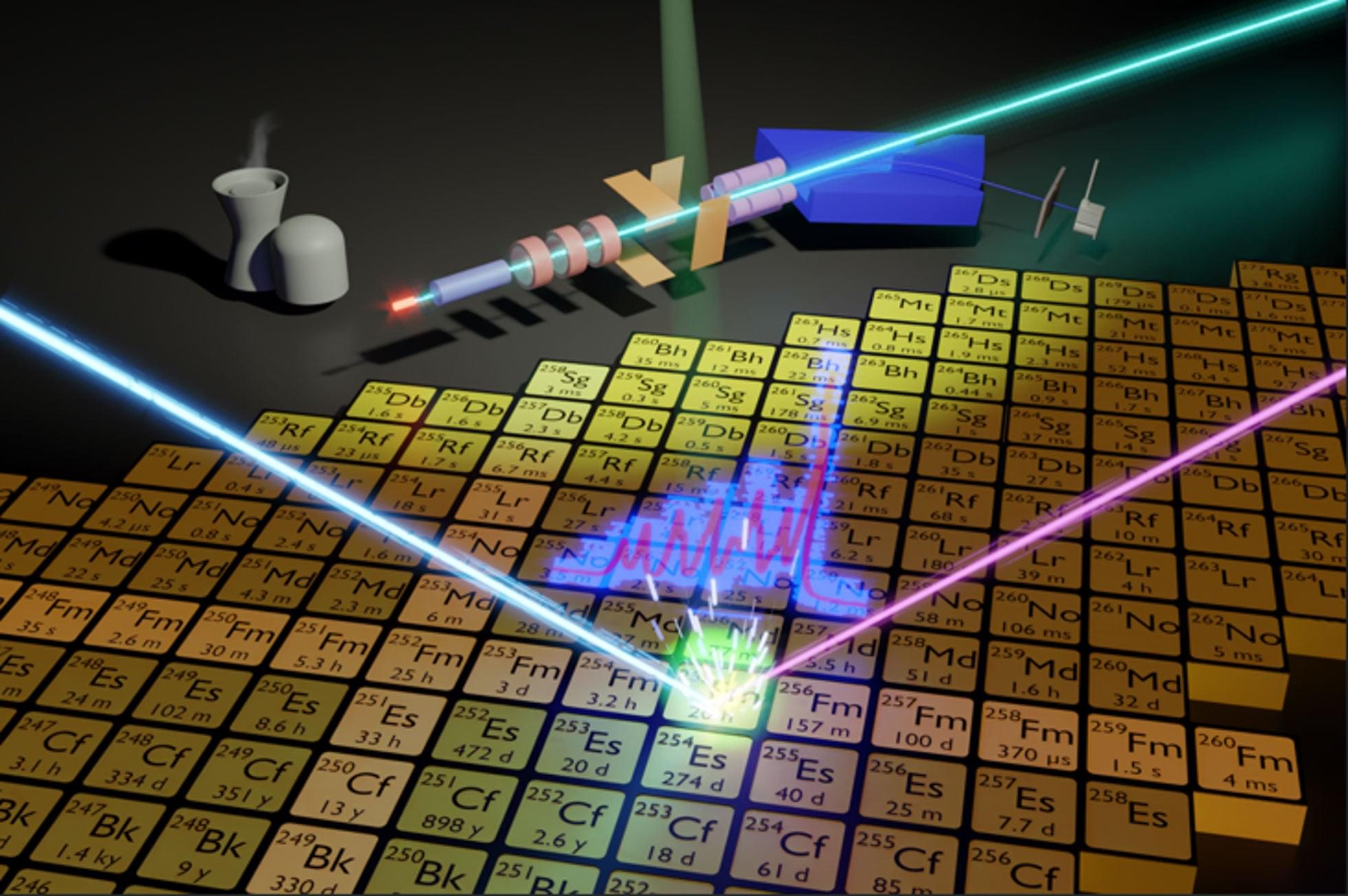
Using advanced laser spectroscopy on extremely rare radioactive material, researchers have uncovered new insights into the structure of heavy atomic nuclei.
The nucleus of fermium-255 is far from spherical. Scientists have now determined its shape for the first time, finding that it is strongly elongated, much like a rugby ball. The high-precision measurements, published in Physical Review Letters, also correct earlier nuclear data and provide new evidence supporting theoretical models of the heaviest elements.
Fermium-255 contains 100 protons and 155 neutrons. In such heavy nuclei, the electrical repulsion between positively charged protons creates conditions that can lead to spontaneous fission, in which a nucleus splits into smaller fragments. Nuclear shape influences this process, making it a critical factor in predicting whether even heavier, potentially longer-lived elements can exist.