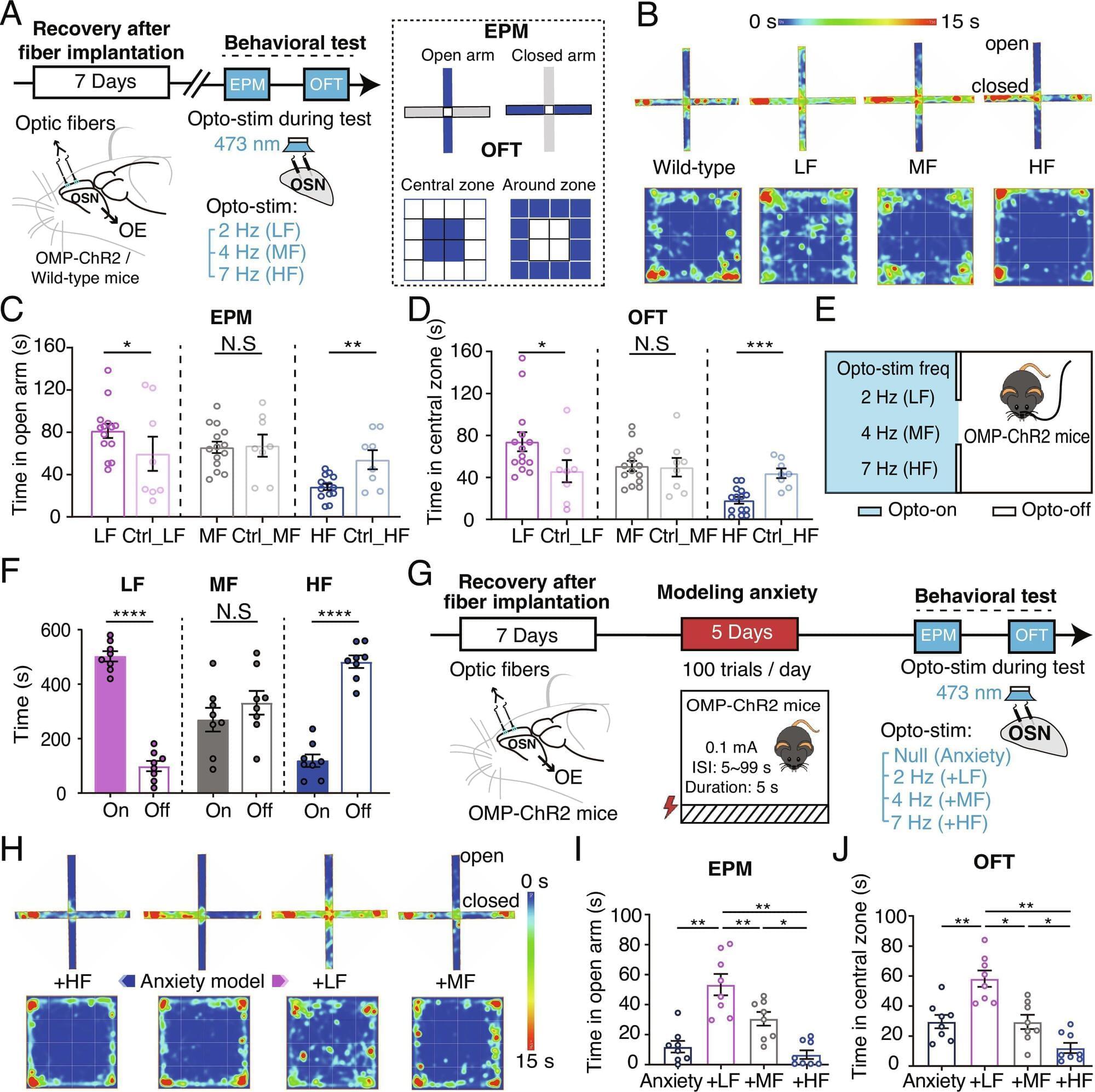
We utilized optogenetics to selectively control the frequency of OSN activity in OMP–hChR2V mice, in which all mature OSNs express Channelrhodopsin-2 (ChR2) (25). Stimulation frequencies were determined by referencing the nasal respiration rates of freely moving mice measured using a pressure sensor monitoring the airflow through a cannula implanted in the nasal cavity (SI Appendix, Fig. S1 A). Based on the distribution of measured breathing rates in quiet awake mice (SI Appendix, Fig. S1 B and C) and documented conscious mouse breathing rates (26 – 28), we categorized 2 Hz as low frequency, 4 Hz as moderate frequency, and 7 Hz as high frequency. Therefore, subsequent OSN stimulation was administered at 2, 4, and 7 Hz to selectively manipulate nasal neural activity at slow, moderate, and fast rates, respectively.
We assessed the anxiety-like behavior effects of manipulating OSNs in mice using the Elevated Plus Maze (EPM) and the Open Field Test (OFT) (Fig. 1A). Notably, low-frequency (i.e., 2 Hz) stimulation significantly increased the time spent in the open arms of the EPM (Fig. 1 B and C) and the central zone of the OFT (Fig. 1 B and D) compared to the control, indicative of anxiolytic effects. In contrast, high-frequency (i.e., 7 Hz) stimulation significantly reduced the time spent in these areas, suggesting anxiogenic effects (Fig. 1 B–D). The moderate-frequency (i.e., 4 Hz) group did not differ significantly from wild-type controls (Fig. 1 B–D). No significant changes in average speed were observed across all stimulation frequencies in both EPM and OFT (SI Appendix, Fig. S2A). OSN stimulation at low, moderate, and high frequencies did not significantly alter behaviors in the EPM and OFT in wild-type mice (SI Appendix, Fig. S3), ruling out visual artifacts as a confound.