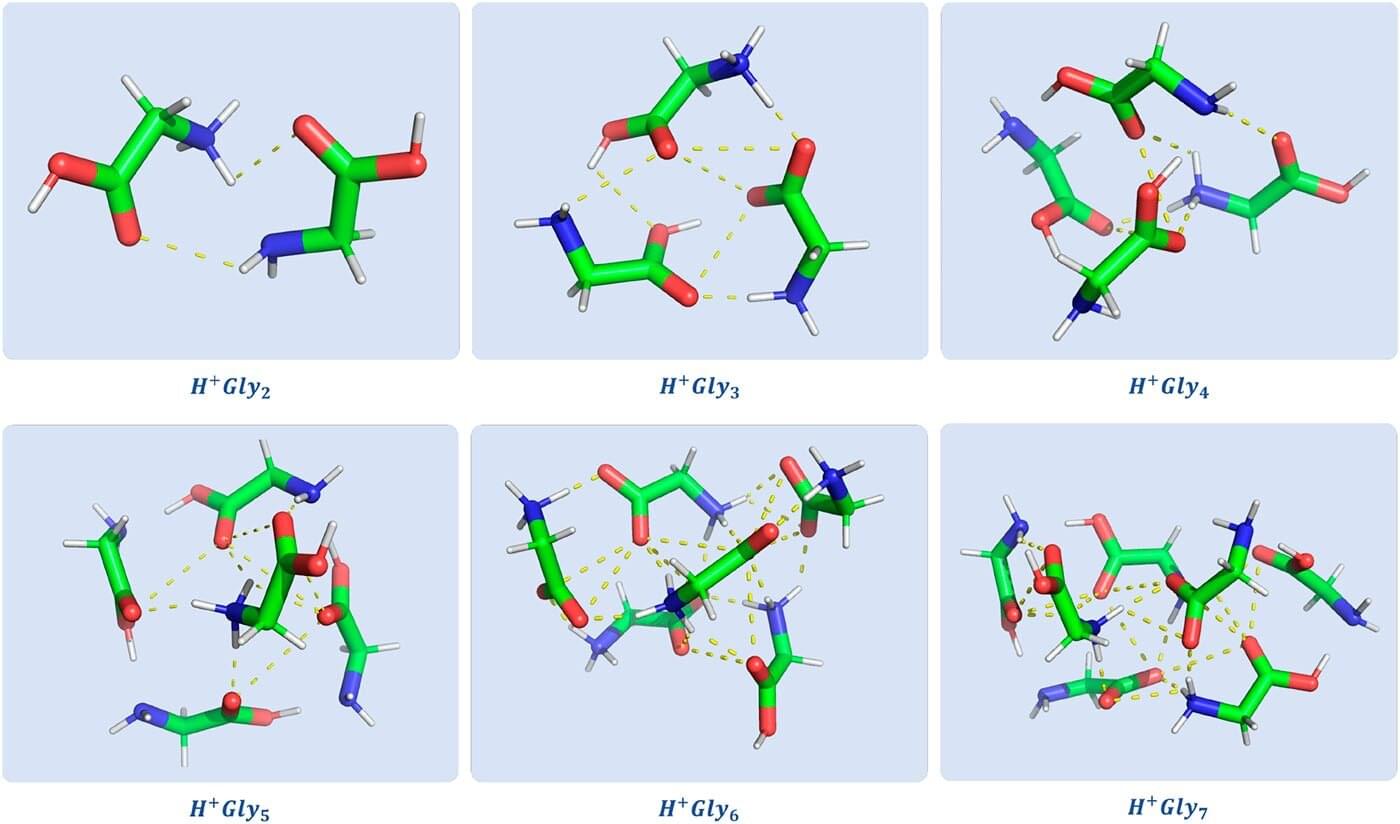
Why are some groups of molecules remarkably stable while others readily break apart? Researchers at Bar-Ilan University have discovered a surprising explanation for why clusters containing exactly six molecules of glycine, the simplest amino acid, are exceptionally stable—making six a “magic number.” Moreover, they have uncovered the reason for this increased stability. The secret lies in a transformation that takes place when the molecules come together: they change their structure and become zwitterions, allowing them to form stronger bonds with one another.
The discovery sheds new light on how molecules interact and organize themselves, offering a new perspective on the chemistry of amino acids and the early molecular processes associated with the origins of life.
Published in the Journal of Chemical Physics, the study combines laboratory experiments with advanced computer simulations to investigate how glycine molecules (and amino acids in general) assemble into clusters.