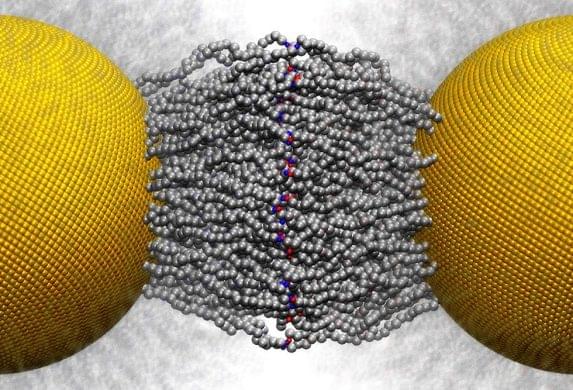
Prof. Rob Macfarlane & team developed a new approach to nanoparticle assembly, using highly flexible connector molecules to control how nanoparticles link together and create materials for photonics, chemical catalysis, medicine, & more. @MITEngineering.
Building Better Microscopic Legos: The Power of a “Squishy” Coating.
Consider building a complex, open-frame structure out of microscopic Lego bricks. Normally, to make pieces connect in specific, limited directions, the bricks themselves need to have special shapes—like distinct bumps, holes, or flat sides.
In nanotechnology, scientists build advanced materials by assembling tiny particles (nanoparticles) into organized structures called superlattices. These particles are typically coated in a layer of sticky molecules (called ligands). However, because these coatings are usually rigid, the particles tend to just clump together into dense, tightly packed clusters, maximizing the number of connections. For a long time, scientists believed that if they wanted to build more complex, open, or directional structures, they had to engineer the nanoparticles themselves to be asymmetrical or specially patterned.
But researchers have now discovered a clever workaround: you can use perfectly round, uniform nanoparticles and still get them to form complex, open structures. The secret lies in making their sticky outer coating flexible.
Think of this flexible coating like a squishy, adaptive layer of Velcro. When the nanoparticles come close to each other, this soft outer layer deforms and shifts. Instead of wrapping evenly around the particle, the molecules reconfigure themselves to line up only at the points where the particles touch. This spontaneous shifting creates natural, specific “bonding spots” (a concept scientists call *valency•, dictating exactly how many neighbors a particle can connect to and in what direction.
Through a combination of laboratory experiments and computer simulations, the researchers proved that by simply tuning how flexible this outer coating is, they can control the final structure. More flexibility leads to fewer connections per particle, allowing the assembly of intricate, less densely packed materials with unique symmetries that were previously thought impossible for uniform, round particles.
This discovery gives scientists a powerful new “knob” to turn when designing materials. Instead of going through the difficult process of engineering complex particle shapes, they can now just adjust the flexibility of the particle’s coating. This opens the door to programming and building a new generation of advanced materials with tailored properties for use in electronics, medicine, energy, and beyond.
#Nanotechnology #chemistry #physics
Creating better-performing materials comes down to having more control over their structure at the smallest possible scale. One particularly effective way to accomplish that is using nanoparticles, which have highly customizable shapes and sizes and have already shown promise in applications across energy, medicine, and electronics.
But the process of turning nanoparticles into useful new materials has been hampered by the difficulty of controlling the number and direction of the links between each particle and its neighbors. Researchers have tried changing the shape of particles or precisely aligning the rigid connector chains between them, but both of those methods limit the material structures nanoparticles are able to form and are difficult to scale.
A team including researchers from MIT is taking a different approach. The researchers developed a tunable way to use super-flexible connector molecules that regulate the packing of nanoparticle networks by intentionally deforming based on their surrounding environment. In a paper published today in Nature Materials, the researchers showed how connector flexibility and electric charges can be used to tune the network’s structure, and they used the technique to create new kinds of nanoparticle-based materials.