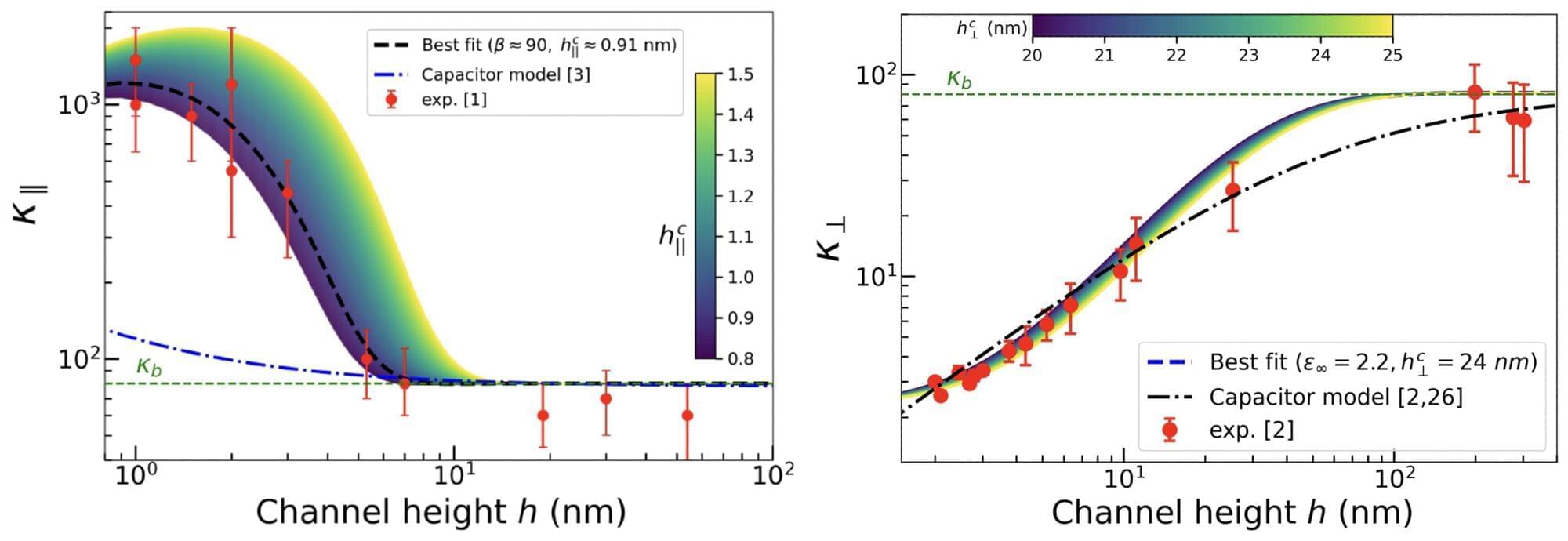
Using an advanced new mathematical model, a pair of physicists in Belgium has revealed the origins of an unusual, direction-dependent effect found in water confined to a narrow gap between two plates. Through research published in Physical Review Letters, Mehdi Neek-Amal and Francois Peeters at the University of Antwerp showed how two drastically different dielectric responses in this water emerge from the natural bonding behavior of its molecules.
Dielectric materials are made up of molecules with built-in electric dipoles: a positive charge at one end and a negative charge at the other. When exposed to an electric field, these dipoles rotate so that their positive ends point in the direction of the applied field and their negative ends in the opposite direction. This polarization creates an internal electric field within the material that partially cancels out the applied field.
In pure water, the dielectric effect emerges due to the tendency of oxygen atoms to pull electrons away from the hydrogen atoms they bond to covalently, creating a dipole across the chevron-shaped molecule. Under ordinary conditions, this creates hydrogen-bonding networks, where the positive hydrogen atoms of one molecule are attracted electrostatically to the negative oxygen atom at the tip of a neighboring chevron.