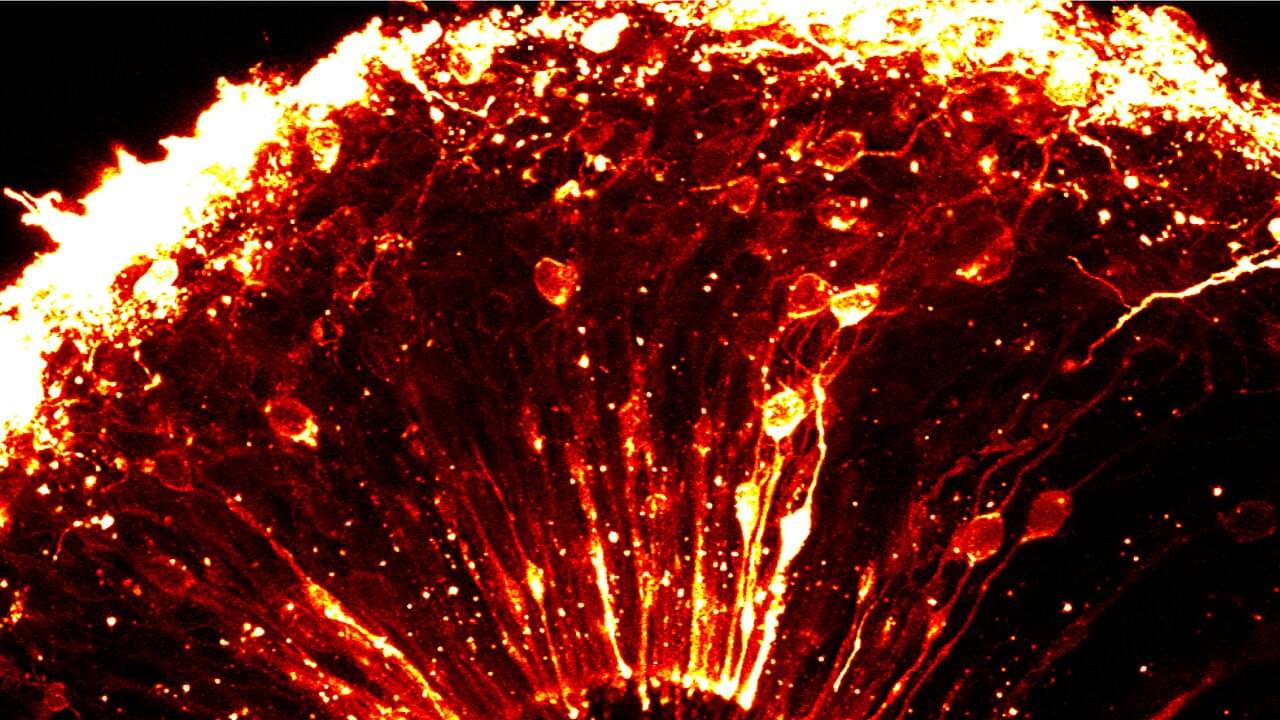
How did the human brain become so much larger than that of our closest evolutionary relatives? Part of the answer lies not in new genes, but in how humans and non-human apes use the genes they share. Using brain organoids grown from stem cells, an international team led by Prof. Mareike Albert at TUD Dresden University of Technology compared early brain development in humans, chimpanzees, and gorillas.
They found that in humans, genetic switches make certain genes more active, which likely make the cells that build the brain more branched—a trait linked to producing more neurons and, in turn, a bigger brain. The study is published in the journal Nature Communications.
In the brain, the neocortex is the area responsible for higher cognitive functions such as abstract thinking, long-term planning and speech. The human neocortex is much larger than that of other great apes. Although certain human-specific genes have been linked to a larger brain, they alone do not explain the massive evolutionary expansion of the human neocortex.