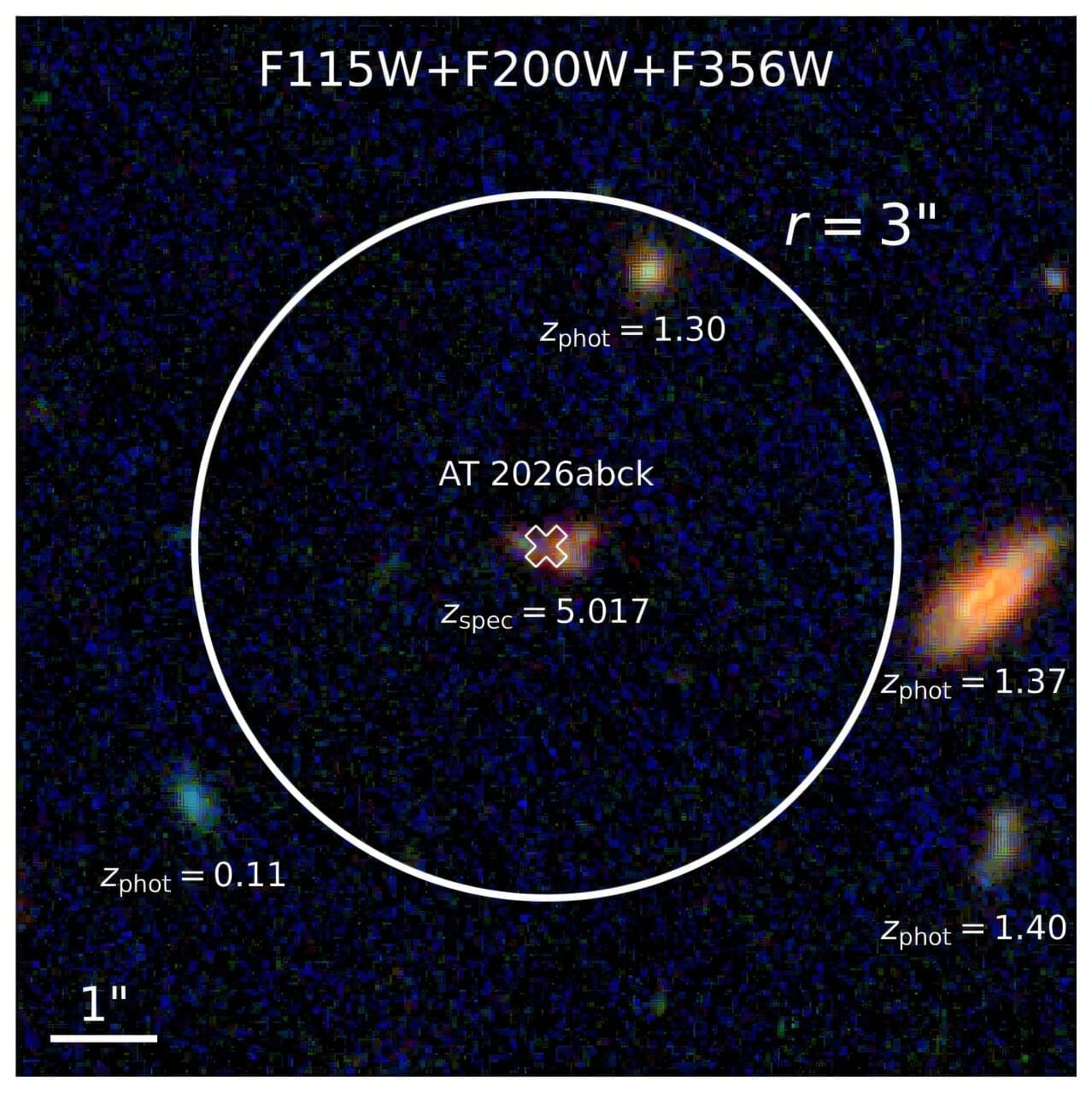
The James Webb Space Telescope (JWST) has detected a possible supernova in the early universe just days after the star exploded. Called AT 2026abck, the transient lies in a star-forming galaxy at a redshift of 5.017 and was found without the help of gravitational lensing. JWST observations suggest the event was caught only about four to 10 days after the explosion. The paper was posted to the arXiv preprint server on Sept. 29.
Supernovae in the early universe offer a direct view of how massive stars lived and died when galaxies were young, metal-poor and forming stars in bursts. Their rate also gives an independent measure of the cosmic star-formation history. But they are difficult to observe because the light they emit gets stretched and redshifted to infrared wavelengths by the time it reaches us.
The James Webb Space Telescope, with its exceptional infrared vision, has made it possible to detect over 200 potential supernova events with host galaxy redshifts out to around 6. Beyond redshift 4 (when the universe’s age was 1.5 billion years), most candidates have been observed only once or a few times, and few have been caught within days of exploding. At redshifts greater than 5, only one supernova has been confirmed based on its spectra, and only because it was gravitationally magnified up to 30 times by a galaxy cluster.