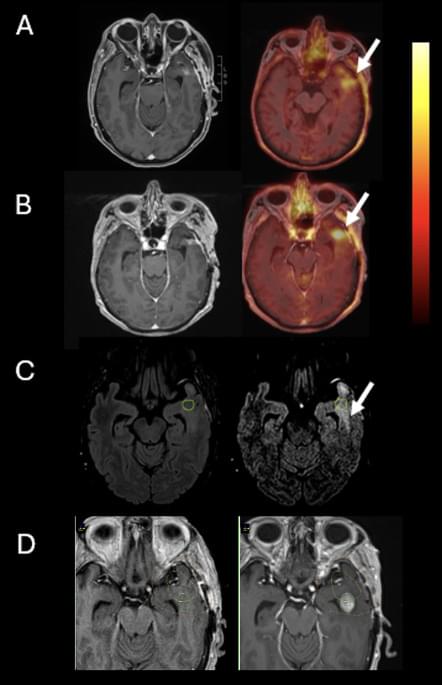
High-grade gliomas carry a poor prognosis, and MRI-based radiotherapy (RT) planning may inadequately capture metabolically active tumor infiltration. ¹⁸F-fluoroethyl-tyrosine (FET) PET provides superior tumor delineation, yet prospective North American evidence supporting integration with RT planning remains limited.
FETSMaRT enrolled 30 patients with WHO grade 3 or 4 high-grade glioma receiving post-operative RT. FET-PET/MRI was acquired before RT with the radiation oncologist blinded to PET, enabling retrospective quantification of discordance between MRI-based and FET-PET/MRI-derived gross tumor (GTV), clinical target (CTV), and planning target (PTV) volumes. In the glioblastoma subgroup (n = 23), Kaplan–Meier and Cox analyses related GTV and CTV discordance to time to progression.
Median age was 60 years; 77% had glioblastoma and 60% MGMT promoter methylation. GTV discordance occurred in 17/30 patients (56.7%) and CTV discordance in 15/30 (50.0%). FET-PET/MRI-derived volumes significantly exceeded MRI-based volumes for GTV (43.6 vs. 38.6 cc; p 0.0001), CTV (119.2 vs. 110.8 cc; p = 0.0045), and PTV (171.1 vs. 159.6 cc; p = 0.0003). Larger GTV∆ and CTV∆ change values were associated with numerically shorter median time to progression, but neither association was statistically significant. Radiation treatment failures were predominantly central (60.0%).